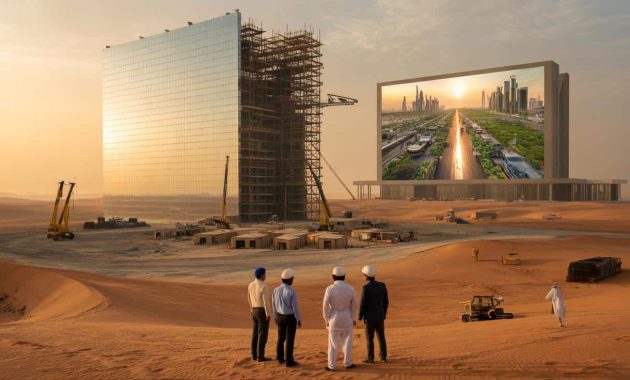
On the edge of the Arabian desert, the marketing screens are still looping the same hypnotic animation. Two perfect glass walls, slicing straight through yellow sand. Flying taxis. Palm trees suspended in the air like a video game. The sales team at a NEOM showroom in Riyadh keeps greeting visitors with rehearsed smiles, even as the questions turn sharper: “So… is The Line still 170 kilometers long? Or is it now just a few clusters?”
Behind the glossy renders and the rehearsed optimism, something has shifted. Contractors are being quietly stood down. Timelines are being “recalibrated”. And the world’s most audacious megacity — a 100-mile straight line in the desert — suddenly looks less like the future and more like a very expensive mirage.
Nobody wants to say it out loud. Yet.
From 100-mile revolution to shortened dream
When Saudi Arabia first announced The Line in 2021, it sounded less like urban planning and more like a sci‑fi trailer. A city with no cars, no streets, no emissions, stretched over 170 kilometers in a razor‑thin strip of mirrored walls and hyper-connected pods. It was pitched as the crown jewel of Crown Prince Mohammed bin Salman’s Vision 2030, a new model of civilization that would drag the kingdom out of oil dependency and into a tech-drenched future.
Investors were flown over the desert in helicopters. Journalists were shown smooth videos and grand charts. The message was crystal clear: this was not a project, this was destiny.
Fast forward to late 2024 and the mood on the ground feels different. Satellite images show construction concentrated on a tiny fraction of that massive line. Reports from within NEOM — the vast region intended to host The Line and other mega-projects — suggest that only a few kilometers of the city will realistically be built by the original 2030 deadline.
Billions of dollars have already been poured into preliminary works, housing for foreign staff, consulting fees, and showpiece events. Workers describe suddenly “paused” contracts, delayed payments, and hurried reassignments to smaller, more conventional buildings. One European engineer who recently left NEOM put it bluntly to a colleague: “We went from rewriting the future to trying to finish a resort.”
Behind the scenes, the math stopped working. With oil revenues under pressure and multiple giga-projects competing for the same pot of money, the 100-mile vision of The Line began to look like a fiscal black hole. Every kilometer of mirrored wall, every futuristic transport pod, came with a price tag running into the tens of billions.
Financial planners started whispering about “phasing” and “right-sizing”, diplomatic language for pulling back without admitting defeat. International partners quietly trimmed their exposure. The dream wasn’t officially canceled, only “re-scoped”. Yet the core promise — a full-length, continuous linear city — is quietly evaporating in the desert heat.
The quiet retreat and the growing anger
The tactical retreat is being staged with care. No dramatic press conference, no apology tour. Just a series of controlled leaks, softened language, and PR pivots from “100-mile megacity” to “innovative urban clusters” and “pilot phases”. NEOM’s social media feeds still push dreamy concept art, but the captions have subtly changed from “will host nine million residents” to “designed to host up to nine million residents”.
➡️ Unexpected discovery: a new life form emerges from the rudder of a research vessel
➡️ Scientists confirm a development that could alter expectations
➡️ Psychology explains that emotional numbness often develops as a short-term survival strategy
On paper, nothing has collapsed. On the ground, everyone feels the contraction. Consultants who were once sketching skytrains are suddenly working on sewage plans for a much smaller footprint. The buzzword has shifted from “revolution” to “realism”.
If you talk to people who bought into the vision early, the frustration is raw. There are Saudis who left stable jobs in Jeddah or Riyadh, moved their families to temporary housing near NEOM, and watched as promised roles evaporated. Foreign specialists relocated from Europe and Asia for high-risk, high-reward careers, only to find projects frozen or massively reduced.
“We didn’t come here to build yet another luxury compound,” one former project manager told a friend after resigning. “We came for the crazy thing.” Online, young Saudis are asking sharper questions: Who signed off these numbers? Who will answer for the billions spent on a fantasy that everyone knew was nearly impossible? *Who takes responsibility when a national dream quietly shrinks in real time?*
The political risk is delicate. The Line was not just a project; it was a symbol of Crown Prince Mohammed bin Salman’s power and ambition. In an absolute monarchy, admitting that such a flagship idea was overreaching is more than a budget issue — it brushes against prestige and authority. So the narrative is being carefully reframed: not as failure, but as a strategic “adjustment” to changing global realities.
Yet the plain-truth sentence many Saudis repeat privately is simple: **the project was too big, too fast, and too expensive**. No amount of glossy storytelling cancels the hard numbers. Debt levels are rising, global interest rates are higher, and the cost of maintaining the illusion of a 100-mile city is now politically heavier than the cost of scaling it down. Someone will eventually have to say it out loud.
What this megacity comedown really teaches us
Strip away the royal titles and the mirrored walls, and The Line’s quiet retreat mirrors something deeply human: our love of grand plans. Governments do it. Companies do it. So do we. We fall in love with the most extreme version of an idea, then crash into the wall of reality.
One practical lesson stands out from NEOM’s turmoil: test small, explain clearly, and resist the urge to sell the final fantasy before the foundations are real. Saudi planners could have started with a 10-kilometer pilot city, open to genuine review, then scaled up gradually instead of locking themselves into a 170-kilometer promise that looked great on stage and terrible on spreadsheets.
For ordinary Saudis, the emotional whiplash is real. One day you’re told your country is building the “civilization of the future”. The next, you discover that future might be reduced to a handful of showcase districts and luxury villas for global elites. We’ve all been there, that moment when a big promise from a boss, a leader, or even ourselves quietly evaporates into awkward silence.
That’s why people are not just asking about money. They’re asking about honesty. Who will say, openly, what went wrong? Who will admit that environmental impacts were underestimated, that water and energy needs were nightmarishly complex, that worker conditions and governance questions were brushed aside in the race to impress the world? Let’s be honest: nobody really does this every single day.
The line between visionary leadership and reckless gamble is thin, and The Line now sits right on it. One Gulf analyst summed it up in private with unusual bluntness:
“The tragedy isn’t that they dreamed big. The tragedy is that they sold the dream as a guarantee, not as an experiment — and they did it with public money and people’s lives attached.”
In the backlash brewing online, three demands keep coming up, almost like a checklist:
- Transparent accounting of how much was spent, on what, and with which foreign firms.
- Clear answers on what will actually be built by 2030, instead of elastic slogans.
- Accountability for decision-makers who pushed unrealistic timelines and budgets without independent scrutiny.
People are not against ambition. **They’re against being treated like an audience, not stakeholders.**
A shrinking city, a bigger question
The most unsettling part of Saudi Arabia’s megacity comedown isn’t just the money burned in the sand. It’s the silence hovering around it. On paper, The Line still exists. Contracts still mention it. Official speeches still use the name. Yet everyone close to the project can feel the scale collapsing, piece by piece, into something smaller, safer, and infinitely less revolutionary.
This leaves an open question that goes far beyond one desert: who gets to dream on behalf of millions, and who answers when those dreams go off the rails? Around the world, leaders are selling climate-proof cities, AI-powered nations, floating districts, Mars colonies. The lesson from NEOM is not “don’t dream”, it’s: start by telling the truth about risk, cost, and limits — even when that truth makes the slides less shiny.
For young Saudis who believed that The Line marked the start of a new era, the coming years will be a test of trust. Will there be a frank reckoning, a clear explanation of what changed and why? Or will the story be quietly rewritten until failure looks like “strategic adjustment” and broken promises are simply forgotten?
What happens next in the desert will send a signal far beyond the kingdom. If a $500 billion mega-dream can shrink with no one clearly answering for it, what does that say about the future of every glittering promise we’re being sold — from Dubai to Silicon Valley?
| Key point | Detail | Value for the reader |
|---|---|---|
| The Line’s scale is being quietly reduced | From a 170 km city for 9 million people to a limited initial segment focused on a few clusters | Helps decode headlines and PR language, see what’s really happening on the ground |
| Billions have already been sunk into the project | Spending on infrastructure, foreign consultants, and early works with uncertain long-term payoff | Offers a concrete sense of the stakes when mega‑visions collide with economic reality |
| Accountability questions are growing louder | Calls for transparency, audits, and political responsibility for over‑promising | Invites readers to think about how power, risk, and public money are handled in their own countries |
FAQ:
- Is The Line officially canceled?The Saudi government has not announced a cancellation. Publicly, the project still exists, but multiple reports indicate that only a fraction of the original 170 km will be built in the near term.
- How much money has Saudi Arabia spent on The Line so far?Exact numbers are opaque, yet estimates run into tens of billions of dollars when you include infrastructure, staff housing, consulting fees, and site preparation within NEOM.
- Why is Saudi Arabia scaling back the megacity vision?Rising costs, tighter global financial conditions, lower-than-hoped oil revenues, and the technical complexity of the concept have all combined to make the full 100-mile city extremely hard to deliver.
- Will any part of NEOM actually be completed?Yes, parts of NEOM unrelated to the full-length Line — such as resorts and smaller urban nodes — are more likely to be completed, though timelines may shift.
- Who could be held accountable for the setback?Formally, responsibility lies within the NEOM leadership and the upper levels of the Saudi state, but in a highly centralized system, clear public accountability is unlikely unless the kingdom chooses a rare moment of transparent self-critique.