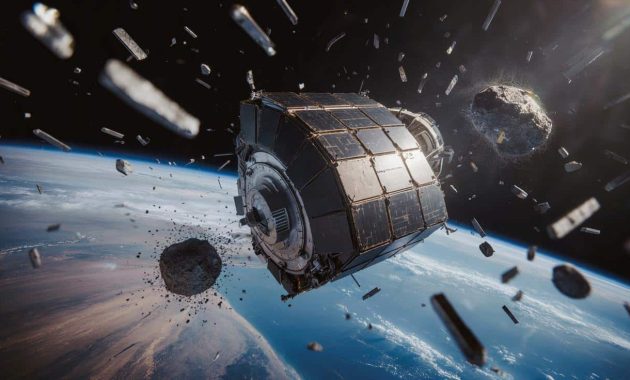
As satellites crowd the skies and debris fields multiply, one US start-up says shielding can no longer be an afterthought, but the backbone of spacecraft design.
Space is filling up – and getting more dangerous
Since the first Sputnik launch in 1957, thousands of rockets, satellites and booster stages have been left circling the planet. Only a small fraction still works. The rest is shrapnel waiting for a collision.
Engineers track big objects, but the real threat often comes from pieces too small to see with radar. A flake of paint or a screw a few millimetres wide can travel at more than 7 kilometres per second. That is around ten times the speed of a rifle bullet.
At those speeds, even a grain-sized fragment can punch straight through a spacecraft wall or an astronaut’s visor.
That is the nightmare scenario driving Atomic‑6, a US materials start-up founded in 2018. The company has designed composite tiles, branded Space Armor, which act like a lightweight armour shell for satellites and potentially for human missions.
A new kind of armour for satellites
Traditional satellite shielding often relies on heavy metal plates or Whipple shields, which sacrifice an outer layer to break up incoming debris. That method works, but it adds mass and can create its own cloud of tiny fragments.
Atomic‑6 is betting on a different recipe: advanced composite tiles that are light, tough and smart about how they interact with both debris and radio waves.
How the tiles are built
The company uses a proprietary process that tightly controls the ratio between fibres and resin inside the composite. That reduces microscopic pores, where cracks and weakness can start during an impact.
Less porosity means the material can soak up and spread the enormous energy released when a micro‑debris particle slams into it. The tile deforms and absorbs the hit, instead of exploding into a hail of new fragments.
➡️ The simple glass trick that keeps a bathroom smelling like a perfumery
➡️ Are “barn eggs” from hens raised in disguised cages?
➡️ What does it mean when people talk very loudly, according to psychology?
➡️ Panic in the Caribbean: giant snakes invade Puerto Rico and endanger local biodiversity
➡️ France and the Rafale lose a €3.2 billion deal after last?minute U?turn
The goal is simple: stop the projectile, and stop the chain reaction of extra debris.
At the same time, the tiles are designed to be permeable to radio frequencies. That is unusual. Most traditional metal shields behave like a Faraday cage and block signals.
Here, engineers can tune the material so that certain communication bands pass through, while others are damped or blocked. That opens up both civil and military uses, from protecting satellite antennas to hiding sensitive signals.
Performance at hypervelocity
According to Atomic‑6, the tiles have been tested against projectiles travelling at around 7.5 km/s, firmly in the hypervelocity regime. That is similar to the relative speeds seen between orbiting debris and satellites in low Earth orbit.
On paper, that performance could even extend to defending against some high‑speed explosive fragments on Earth, such as those produced by powerful conventional explosives. The company says tests for these defence‑oriented scenarios are under way.
First major test: the Starburst‑1 satellite
The real validation for any space technology is flight. Atomic‑6’s first headline customer is Portal Space Systems, a US firm working on a highly manoeuvrable satellite called Starburst‑1.
Starburst‑1 is built for so‑called rendezvous and proximity operations: sneaking up on, inspecting and servicing other spacecraft. That kind of mission needs agility and long life, which means any single hit from debris could be mission‑ending.
Portal Space Systems has chosen the Atomic‑6 tiles as Starburst‑1’s primary protection system, not a bolt‑on extra.
The satellite is scheduled to launch on a SpaceX Falcon 9 in October 2026. On board, Space Armor tiles will be monitored by cameras and sensors.
- Onboard cameras will watch for impacts on the tiles’ surface.
- Telemetry data will track whether any hit has damaged key systems.
If the satellite can shrug off multiple hypervelocity strikes with no loss of capability, that will serve as a powerful demonstration for insurers, governments and commercial operators worried about debris risk.
Beyond orbit: other uses for space armour
Atomic‑6 is already pitching its technology well beyond that single mission. Because the tiles are both RF‑transparent and extremely impact‑resistant, the same concept can fit several markets.
Protecting astronauts on spacewalks
Outside the International Space Station, astronauts already face micro‑debris and micrometeoroids with only a few layers of fabric, metal and foam between them and vacuum. As orbits get busier, that risk rises.
The company is working on embedding its armour into future spacesuits, especially in areas like the torso and helmet, where a single puncture would be catastrophic. The challenge lies in combining protection with flexibility and keeping weight low enough that astronauts can still move.
Defence, antennas and critical infrastructure
On the ground, sea and in the air, many communication hubs and radar systems are essentially delicate electronics in thin enclosures. They are exposed to shrapnel, storms, vandalism and, in some scenarios, directed‑energy weapons.
Because the tiles let chosen radio frequencies through, they can form a hard, impact‑resistant outer shell for radar domes, satcom terminals, UAV antennas or ship‑borne systems. Signals keep flowing, while kinetic and thermal threats are diminished.
A single material that passes RF signals, blocks bullets of debris and soaks up heat is attractive for militaries and telecoms alike.
Atomic‑6 also mentions work on protecting infrastructure from emerging directed‑energy threats. Here, the composite’s thermal behaviour matters: the material needs to spread and dissipate concentrated heat without cracking or charring to the point of failure.
Racing against the Kessler syndrome
Behind all this sits a bigger fear: the Kessler syndrome. This scenario, first proposed by NASA scientist Donald Kessler, describes a chain reaction in which one collision creates a cloud of fragments. Those fragments cause further collisions, which create even more debris, and so on.
Once that cascade starts in a particular orbital band, it could make that region unusable for decades. Some experts argue we are approaching the first stages of that process in crowded low Earth orbits.
| Object size | Estimated number in orbit | Tracking status |
|---|---|---|
| > 10 cm | Tens of thousands | Routinely tracked and catalogued |
| 1 cm – 10 cm | Hundreds of thousands | Partially tracked |
| < 1 cm | Millions | Effectively untrackable |
Armor like the Atomic‑6 tiles does not remove debris. It does something more modest but still valuable: it stops each impact from turning one object into thousands of new fragments. That helps slow the runaway multiplication of junk.
Changing how spacecraft are designed
One of the more radical ideas from Atomic‑6’s founder is that shielding should no longer be treated as an afterthought. Historically, satellites were designed first, with protection added late in the process if the mass budget allowed.
With debris levels rising, the company argues that armour has to move into the primary structure. That means engineers will shape spacecraft frames, panels and antenna covers around the protective material from day one.
For future insurers, robust shielding could become as non‑negotiable as a heat shield on a re‑entry capsule.
This shift changes trade‑offs. Designers might choose slightly heavier tiles but then relax requirements elsewhere, relying on survivability instead of pure manoeuvrability to avoid debris.
Signal control and military interest
A less obvious feature of the technology is signal management. Composites can be engineered to behave differently at different frequencies, and the Atomic‑6 system takes advantage of that.
- RF transparency: The armour can let specific communication bands pass through with minimal loss.
- Signal masking: Other frequencies can be blocked or heavily attenuated, acting as a kind of built‑in electronic stealth layer.
That dual behaviour has caught the eye of the US defence community. The company’s work has been backed by the Air Force Research Laboratory’s Space Vehicles Directorate through innovation grants aimed at replacing legacy, heavy metal Whipple shields with lighter composite structures.
In a contested orbit, a satellite that can physically withstand hits and shape what its antennas send and receive becomes a more resilient and less predictable asset. That mix of kinetic protection and signal control turns a simple “shield” into a complex defensive system.
Key concepts worth unpacking
Two technical ideas help explain why this new armour matters: hypervelocity impacts and porosity.
Hypervelocity refers to speeds above roughly 3 km/s, where objects behave very differently on impact. Metals can flow like liquid in microseconds, and shockwaves race through structures faster than cracks can form. Testing at these speeds needs special light‑gas guns or orbital experiments, which makes real‑world data expensive but crucial.
Porosity is the amount of empty space within a solid material. High porosity gives cracks and fractures a place to start. By squeezing out those tiny voids, composites can spread impact forces more evenly, reducing the chance that a single small hit will create a catastrophic fracture.
Together, these ideas shape how engineers think about future spacecraft skins: as active, engineered layers that manage energy and signals, not just simple metal walls.
What this could mean for everyday space users
If technologies like Space Armor move from niche experiment to industry standard, the effects will ripple quietly through everyday life. Broadband from orbit, global navigation signals, climate monitoring and secure military communications all rely on constellations in low Earth orbit.
More resilient satellites mean fewer sudden outages from unexplained failures, more predictable insurance costs and greater confidence in long‑term mega‑constellations. At the same time, better shielding does not remove the need to clean up existing debris or enforce smarter launch rules. It simply buys time and reduces the damage each future collision can cause.