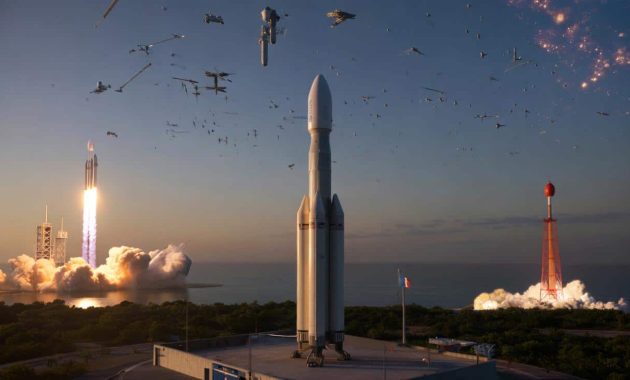
Long seen as Europe’s anchor in space, France now faces a harsher landscape: powerful private players, assertive Asian nations and an American partner that acts less like a guarantor and more like a competitor. Paris talks about “space sovereignty”, but turning that slogan into launch pads, satellites and real autonomy is another matter entirely.
From space pioneer to squeezed middle power
France helped build modern space Europe. Ariane rockets flew from French Guiana, French engineers drove major ESA programmes, and Paris was often first to push for ambitious missions. That image no longer matches reality.
Within the European Space Agency, Germany now contributes more funding than France: roughly 23% of ESA’s budget, against about 16.4% for Paris. That shift sends a clear signal about who sets priorities in Europe.
At the same time, the global hierarchy has hardened. The United States, backed by SpaceX and other private giants, dominates commercial launches and deep space efforts. China, with its state-driven programme, is catching up fast in lunar missions, crewed flights and military space capabilities.
France is no longer a leading pole between two super-blocs; it is a mid-sized power trying not to lose strategic altitude.
In this setting, “space sovereignty” can’t mean beating SpaceX on launch prices or overtaking China on Moon landings. It instead points to a narrower but crucial ambition: keep control over key technologies, retain an independent way into orbit, and avoid strategic dependence on foreign suppliers.
Macron’s space command and the return of hard security
In November 2019, President Emmanuel Macron inaugurated France’s Space Command in Toulouse. It signalled a shift: space is no longer just about science, weather and television; it is also a contested military domain.
France has long relied on satellites for secure communications, intelligence and navigation. The new command pulls those capabilities under one roof and prepares for a future where interference, jamming or even direct attacks against satellites are no longer hypothetical.
French officials talk openly about “space defence”, not just “space policy”, reflecting concerns about Russian, Chinese and even commercial capabilities in orbit.
➡️ Every autumn, gardeners make the same mistake with their leaves
➡️ 1,800-year-old ‘piggy banks’ full of Roman-era coins unearthed in French village
➡️ How Cats Show Affection: When They Do This, You’re Their Favourite Human
➡️ At odds with the family, one heir refuses to see the notary: can the estate still be settled?
➡️ Scientists Identified a New Blood Group After a 50-Year Mystery : ScienceAlert
➡️ Bird lovers use this cheap December treat to keep feeders busy and attract birds every morning
The creation of this command fits into a broader “national space strategy” meant to align civil, commercial and military priorities. Yet the gap between strategy papers and hardware in orbit remains wide, and budgets are limited.
Ariane’s troubled decade and the question of access to orbit
Access to space is the foundation of sovereignty. If a country must book a seat on someone else’s rocket, its strategic autonomy quickly becomes theoretical.
The European Ariane programme, long a symbol of reliability, has struggled. Ariane 5 retired, Ariane 6 suffered repeated delays, and Europe found itself in the awkward position of occasionally buying launches from SpaceX — including for institutional missions.
French officials say the “era of endless setbacks” for Ariane is ending as Ariane 6 enters service. The new launcher is supposed to bring costs down and secure a stable European route into orbit from the Kourou spaceport in French Guiana.
- Ariane 5: workhorse of European launches for decades, now retired
- Ariane 6: new heavy-lift rocket, designed to be more flexible and cheaper per launch
- Vega / Vega-C: smaller launchers, hit by technical and political difficulties
Even with Ariane 6, France and Europe will struggle to match SpaceX on price or cadence. Falcon 9’s reusability and dense launch schedule have reset expectations across the industry.
French industry can still launch, but not like SpaceX: fewer flights, higher prices, and different strategic goals.
Galileo, secure communications and areas where France still weighs in
Not all space power is about rockets. France has invested heavily in the European Union’s flagship constellations, which underpin daily life on the ground.
Galileo: Europe’s answer to GPS
Galileo, the European satellite navigation system, offers highly accurate positioning independent of the US GPS, Russian GLONASS or Chinese BeiDou. France is one of the programme’s main contributors, both politically and industrially.
As more satellites join the constellation, Galileo’s services gain precision and reliability. For European militaries, its encrypted signals offer a navigation option that cannot be shut down by Washington at a sensitive moment.
Secure communications constellations
Europe is also deploying secure communication satellites designed to give governments and armed forces robust links across continents and oceans. Again, French aerospace firms play a central role in building and operating this hardware.
In navigation and secure communications, France is not a follower of the United States or China; it is a core architect of European autonomy.
These constellations form the quiet infrastructure of sovereignty. Without them, navigation apps, air traffic control, financial transactions and military operations would depend on foreign goodwill.
Facing SpaceX: competitor, supplier, or necessary evil?
SpaceX occupies a unique place in French and European debates. Its reusable rockets cut launch costs, its Starlink constellation competes with European telecom plans, and its Mars rhetoric inflames imaginations and budgets alike.
For French players, SpaceX is simultaneously:
- a rival in the commercial launch market
- a service provider when no European rocket is available on time
- a technology benchmark that shapes expectations from customers and politicians
European space companies struggle to raise the same level of risk capital, and political decision-making in Brussels and Paris moves far slower than in Silicon Valley. That gap makes direct head-to-head competition unrealistic in the near term.
Instead, French actors often focus on niches: high-reliability satellites, defence systems, sophisticated instruments and services that sit on top of raw launch capacity.
China, India and the crowded geopolitical orbit
Alongside the US and its private giants, France now contends with rapidly advancing Asian players. China sends taikonauts to its own space station, targets the Moon and Mars, and fields a growing suite of military satellites.
India has achieved low-cost launches, a lunar landing and an interplanetary mission, and is aiming for human spaceflight. While not yet at the level of China or the US, New Delhi is an increasingly attractive partner and competitor for emerging space nations.
France must navigate a landscape where alliances are fluid, and where countries like India can be both partners on one mission and bidders against French firms on the next.
These shifts leave little room for complacency. Being “European champion” no longer automatically implies global influence.
Can France still claim genuine space sovereignty?
On its own, France cannot match the budgets or industrial scale of the US or China. Its path runs through European cooperation, shared infrastructure and selective specialisation.
| Domain | French position | Main challenge |
|---|---|---|
| Launchers | Core role in Ariane 6 and Kourou | Competing with low-cost, reusable rockets |
| Navigation | Key contributor to Galileo | Keeping pace with upgrades to GPS and BeiDou |
| Military space | Dedicated Space Command and spy satellites | Protecting assets in a more hostile orbit |
| Commercial services | Strong Earth observation and telecom firms | Facing Starlink, Amazon Kuiper and Chinese constellations |
Paris can still shape European rules on space traffic management, debris mitigation and defence cooperation. It can push for shared funding of reusable technologies, small launchers and sovereign constellations for broadband or defence.
Concepts and scenarios that will shape France’s next decade in space
Several terms crop up again and again in French policy debates, and they point to where decisions will bite.
What “sovereignty” really means in orbit
In practice, space sovereignty for France covers several layers:
- Technical: know-how to design critical components and satellites
- Industrial: factories and supply chains located in Europe
- Operational: the ability to launch and operate missions without foreign approval
- Legal: European rules that safeguard data, security and environmental standards
These layers can come apart quickly. A launcher might be built in Europe but depend on imported electronics. A satellite might fly on a foreign rocket, raising awkward questions during a diplomatic crisis.
Risk scenarios French planners watch
Defence analysts in Paris model situations that would stress France’s space posture. Typical scenarios include:
- a major conflict in which GPS access is degraded or restricted, pushing Europe to rely on Galileo
- a cyberattack against ground stations managing secure communications
- a collision or deliberate strike that destroys a key military satellite, creating debris
- a commercial crisis where a foreign constellation dominates European broadband, sidelining local operators
Each scenario forces hard questions: how redundant are French and European systems, how quickly can they be replaced, and who controls the key levers during a crisis?
As France weighs answers, its room for manoeuvre narrows. Acting alone brings pride but limited scale. Acting only through Europe risks dilution. Space sovereignty, in practice, will sit in the tension between those two poles — and the performance of Ariane 6, Galileo and future constellations will show whether Paris can still hold its orbit between SpaceX and Beijing.