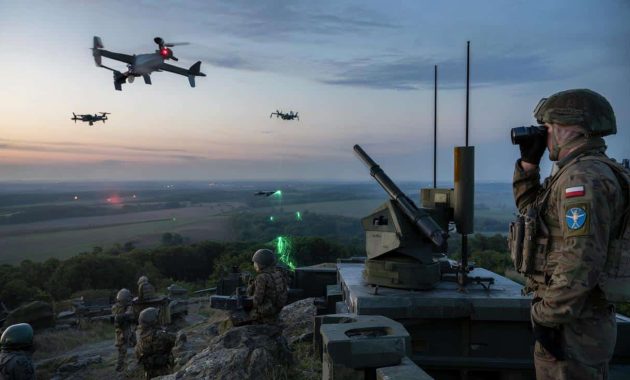
Across Europe’s skies, drones have become the latest test of nerve and technology. Now Poland, sitting on NATO’s frontline with Russia and Belarus, is preparing a response hefty enough to change how the continent thinks about air defence.
Poland’s frontline anxiety turns into action
Polish officials say they have watched a steady rise in unidentified drones crossing their eastern border, many believed to be Russian. In one month alone, security sources counted more than a dozen suspected Russian devices slipping into Polish airspace.
These were not just minor airspace violations. Warsaw treated them as a sign that its skies were being probed, its reactions measured, and its defences tested. The government triggered consultations under Article 4 of the NATO treaty, the mechanism used when a member state feels threatened.
Poland is now treating small drones the way previous generations treated tanks at the border: as a strategic warning sign, not a technical nuisance.
From that point, the political tone hardened. The defence ministry, led on this project by deputy defence minister Cezary Tomczyk, launched plans for an expanded military presence and new technology along the eastern flank. Officials describe it as a step from ad‑hoc responses to a permanent, layered shield against drones and other low-flying threats.
A €2 billion anti-drone shield on the EU’s tab
At the core of the project is money – and a lot of it. Poland is committing more than €2 billion to a new air-defence infrastructure tailored to drone incursions. That spending is nested inside a much larger EU support package under the SAFE programme, which earmarks around €43.7 billion for Poland’s defence-related upgrades.
The timeline is brisk by defence standards. Warsaw wants the first capabilities active in about six months, with full deployment in roughly two years. That pace reflects both political urgency and the rapidly changing technology on the battlefield next door in Ukraine.
European cash is paying for a Polish shield that, in practice, will serve as a testbed for how the EU handles hostile drones across the bloc.
What the new system will actually include
The planned network is not built around a single “silver bullet” weapon. Instead, it combines different tools designed to detect, confuse or physically destroy drones approaching Polish territory.
➡️ Why soaking onions in cold water for 10 minutes changes everything in the kitchen
➡️ The United Kingdom Had Never Seen A Year Like 2025
➡️ Most people rush this daily moment without realizing how much it drains them
➡️ The breakfast cardiologists prefer to protect heart health
➡️ The reason some plants recover quickly after storms while others never do
- Heavy and multi-barrel machine guns to target low-flying drones at short range.
- Autocannons and other artillery able to cover wider sectors and higher altitudes.
- Short- and medium-range missiles to hit drones that fly too high or too fast for guns.
- Electronic jamming systems to cut communications links and satellite navigation.
These systems will be woven into an existing defence line created about a decade ago, originally aimed at more traditional threats. The upgrade turns that older network into a more flexible barrier against both classic aircraft and today’s smaller, cheaper drones.
Eastern flank coalition: not just a Polish problem
Poland’s move is not happening in isolation. Eight countries close to Russia, with Poland and Finland in the lead, are forming a joint initiative branded as “surveillance of the eastern flank”. The aim is to mesh sensors, radar feeds and response plans along NATO’s exposed border, from the Baltic to the Black Sea.
Polish prime minister Donald Tusk has framed this as both national necessity and European responsibility. By co-running the coalition with Finland, a recent NATO entrant with long experience managing a Russian frontier, Poland wants to show it is not simply asking for protection, but helping provide it.
| Goal | What it means in practice |
|---|---|
| Shared surveillance | Pooling radar, acoustic and satellite data on drones along the eastern border. |
| Faster alerts | Common procedures so a drone tracked over one country is instantly flagged to neighbours. |
| Coordinated response | Aligning rules for tracking, warning and, if needed, shooting down intruders. |
| Political signalling | Showing Moscow that probing one border triggers a reaction from several capitals. |
This shared setup also reduces the risk that one state overreacts, or that another ignores a pattern of tests that, together, look far more serious.
Why spy drones matter more than their size
Military planners used to focus on jets and missiles. Today, a cheap quadcopter can provide live video from over a base, track troop movements or map radar positions. That intelligence can then guide artillery or missile strikes, or simply reveal vulnerabilities for later use.
Drones are also deniable. A state can claim that a device strayed by accident, was launched by irregular forces, or was simply “unidentified”. That ambiguity makes them a useful tool for pressure and intimidation without crossing the clear line of a conventional attack.
For Poland, every unidentified drone is both a tactical question – what is it doing? – and a political one – who is sending it, and why now?
The conflict in Ukraine has shown how quickly drone tactics evolve. Small commercial models have been modified into one-way explosive devices. Larger craft drop grenades with surprising accuracy. Long-range drones strike deep into territory once thought safe.
Concerns spreading across Europe
Other European states are watching Poland’s plans with a mix of relief and unease. Relief, because a strong shield on the eastern flank reduces pressure elsewhere. Unease, because ramped-up military posture brings the region a step closer to miscalculation.
Civil aviation experts worry about crowded skies near borders. The more jamming and anti-air measures deployed, the higher the risk of interference with civilian signals or misidentification of aircraft. Local communities living close to the frontier also face more checkpoints, more patrols and more drills.
Scenarios that keep planners awake
Defence analysts in Warsaw and Brussels are already gaming out scenarios that test the new Polish system and the eastern coalition.
- “Grey-zone swarm”: Dozens of cheap drones cross the border in a short burst. Each is individually insignificant, but together they saturate radar and stress response units.
- “Masking manoeuvre”: Several drones fly near a sensitive installation while a separate cyberattack targets communications. The aim is to see how well Poland coordinates between digital and physical defence.
- “Legal trap”: A drone crashes in Poland carrying parts that could be traced to a Russian supplier, but no direct link to the state. The political debate becomes almost as complicated as the technical investigation.
In such scenarios, success is not just downing drones, but handling the messaging, avoiding panic and maintaining unity among NATO and EU partners.
Key terms shaping the drone debate
Several pieces of jargon are now filtering from military circles into public debate in Poland and across Europe.
Anti-access/area denial (A2/AD): This term describes systems designed to make it extremely hard for an adversary to enter or operate in a region. Traditionally linked to missiles and air-defence, it now increasingly includes anti-drone layers.
Electronic warfare (EW): Instead of blowing drones out of the sky, EW tries to blind or confuse them by jamming radio links, distorting GPS signals, or feeding false data. This can be less dramatic than a missile launch, but just as decisive.
Grey-zone operations: Actions that sit below the threshold of open war – like drone incursions, cyberattacks or disinformation – yet still apply pressure. They are designed to create uncertainty and erode confidence rather than trigger a clear military response.
Risks and trade-offs of a hardened border
Building a stronger shield brings its own set of risks. When both sides deploy more sensors, radars and weapons in close proximity, the chance of misreading an incident grows. A drone that loses control and drifts across the border could be mistaken for a hostile probe.
There is also the balance between security and civil liberties. Expanded surveillance along the frontier may affect residents, from farmers flying agricultural drones to journalists covering migration routes. Clear rules on what can be tracked, stored and shared will matter as much as the guns and missiles themselves.
Poland’s anti-drone push is about hardware, but it will force Europe to debate where security ends and everyday life begins.
For now, Warsaw is racing to put its new systems in place before the next wave of drone incursions. The shield being built on its eastern edge will not only protect its own airspace. It will likely shape how the rest of Europe responds when unmarked drones start appearing over its fields, cities and borders.