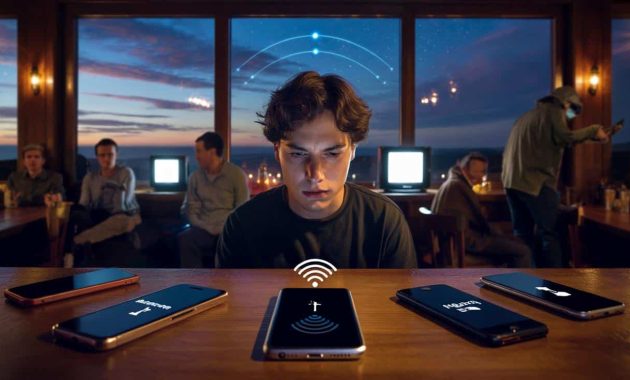
The bar’s Wi-Fi had just died, right in the middle of a Champions League match. People stared at their phones, then at the black TV screen, then at the annoyed bartender rebooting a dusty router that had probably seen three owners and a pandemic. On one table, a guy pulled out his phone, frowned, and mumbled: “I’ve got Starlink. But not here, obviously.” Everyone shrugged. Satellites are for cabins in the woods and off-grid YouTubers, not for the middle of town when fiber has a meltdown.
Then the push notification arrived: Starlink had quietly announced something new. No dish. No special phone. Just satellite internet, directly on your mobile.
For a second, the dead bar felt like the past.
Starlink’s big swing: satellite internet that follows you like 4G
Starlink’s new “Direct to Cell” offer sounds almost unreal on paper. You keep your existing smartphone. You keep your usual SIM card. You walk under the sky, your normal signal dies… and your phone silently flips to Starlink’s satellite network in the background. No white pizza box on a roof, no engineer, no app asking you to aim your dish at the heavens.
For users, it just feels like an extra bar of reception suddenly appearing where there was nothing before.
SpaceX has already started testing this with partner operators, with early trials showing basic text messaging working first, then voice and data in the next waves. The promise is simple: dead zones on the coverage maps begin to shrink, one firmware update at a time. Think about remote highways, coastal villages, long train rides, or that one valley where your usual network just disappears.
One engineer working on the project described it as “filling in the white spaces of the world’s network with the sky itself.”
The technology behind this is dense, but the principle is almost poetic. Starlink’s low‑orbit satellites receive a special mobile signal from your phone, then route it back to terrestrial networks, acting like giant flying cell towers. Your phone doesn’t become a satellite phone in the old-school sense, just a slightly smarter one that can speak a new radio “accent”.
The trick is doing all that without draining your battery in an hour or forcing you to buy a $1,000 rugged brick with an antenna the size of a toothbrush.
How this will really change your daily life (and where it won’t)
On paper, the magic button is: do nothing. You don’t change phones. You don’t buy an extra gadget. You just walk into a coverage agreement between your operator and Starlink. From your side, it’s a tiny icon change at the top of your screen and a bar of signal where your phone used to be a useless rectangle.
The clever part is that Starlink is plugging into carriers, not replacing them.
We’ve all been there, that moment when Google Maps freezes in the middle of a mountain road and the blue dot stops just before the hairpin bend. Imagine that same scene, but your phone quietly switches to satellite mode for a few precious minutes. No drama, no “no service” panic, just enough bandwidth to load the map, send a WhatsApp voice note, or call for help.
A farmer in a rural area, a delivery driver in the countryside, a lone hiker at the edge of the network – these are the real test cases, not tech conferences.
There is a catch, and it’s worth saying plainly: at first, this won’t replace your normal 4G or 5G. Bandwidth will be lower, latency higher, and early plans will likely focus on messaging and emergency use before streaming and TikTok binges. That’s not a bug, that’s the only way this works at global scale.
Let’s be honest: nobody really needs to watch 4K cat videos from the top of a glacier, but sending your GPS location from there might matter a lot.
How to prepare now: habits, expectations, and a few smart moves
You won’t have a “Starlink phone” on your shopping list. What you can do instead is watch what your carrier announces over the next year. The real power move is picking an operator that signs a roaming deal with Starlink once the service expands. That’s the invisible switch that turns your normal phone into a sky-connected lifeline.
If you live, travel, or work in a coverage gap, this choice will matter more than the color of your phone.
A common trap will be overestimating what this new connection can handle. Satellite to phone sounds limitless, almost sci-fi, and that’s exactly where frustration creeps in. This link will likely favor text, calls, low-bandwidth data, and safety services first. High-speed video and heavy downloads will stay better on ground networks and Wi‑Fi.
Instead of seeing it as a new “super internet”, think of it as a backup parachute quietly folded inside your pocket.
*“Direct-to-cell isn’t about giving you Netflix in the desert,” a telecom analyst told me. “It’s about making sure your phone still works when everything else stops.”*
➡️ People over 65 often underestimate how much this daily choice affects their mood
➡️ Goodbye air fryer: new kitchen gadget goes beyond frying with 9 different cooking methods
➡️ This everyday aromatic ingredient drives pests away instantly and keeps homes rodent-free for months
➡️ A French researcher has uncovered the reasons behind the Atlantic’s dangerous overheating
- Check your phone’s compatibility
Look for mentions of “NTN” or satellite compatibility in future updates from your manufacturer or carrier. - Follow Starlink’s coverage maps
These will expand region by region, and early adopters in rural or coastal areas will benefit first. - Update your emergency habits
Share your live location before trips, keep critical contacts pinned in your messaging apps, and learn how your phone signals when it’s on satellite. - Watch the small print on pricing
Some carriers may bundle satellite access in premium plans, while others may bill per use, especially for data. - Don’t throw away your offline tools
Downloaded maps, paper numbers, and basic preparedness still beat any network during a full blackout.
The sky is becoming part of the network – and that changes our mental map
For years, we’ve lived with a silent rule: connection belongs to cities, big roads, and places with cables in the ground. Beyond that border, we accept the little “No Service” label as a kind of tax for wanting silence, nature, or cheaper land. Starlink’s mobile satellite push is quietly redrawing that border.
Not with a dramatic revolution overnight, but with thousands of small, almost invisible connections lighting up where nothing used to work.
This shift won’t feel like the arrival of 4G did, with glossy ads and speed tests shared on social media. It will feel softer and more personal. A lost hiker who can text their family. A fishing boat that can send photos from far offshore. An isolated village that suddenly plugs into the same group chats as the city. The real story is not the satellites; it’s the people who stop being “off the map” without changing phones.
And that’s where the questions start: if everywhere is connected, where do we really disconnect?
| Key point | Detail | Value for the reader |
|---|---|---|
| Existing phone compatibility | Direct-to-cell works with standard smartphones via carrier deals, no special Starlink handset required | Reassures you that you won’t need to buy new gear to benefit |
| Realistic performance | Initial focus on messaging, calls and low-bandwidth data, not full-speed 5G replacement | Helps you set expectations and avoid disappointment or overreliance |
| Choosing the right carrier | Operators partnering with Starlink will offer satellite fallback in coverage gaps and emergencies | Guides your next plan or carrier decision if you live or travel in dead zones |
FAQ:
- Will I need a special Starlink phone?In principle, no. The idea is that normal 4G/5G phones connect to Starlink satellites through your existing carrier, as long as there’s a technical and commercial agreement in place.
- Will I be able to stream video over Starlink satellite on my mobile?At first, this kind of usage will be limited. Early deployments will prioritize text, calls, and basic data. Streaming might work, but it’s not what the system is optimized for in its first phase.
- How much will mobile Starlink satellite access cost?Pricing will vary by country and by carrier. Some operators may bundle it into premium plans, others may charge per message, per minute, or per megabyte when you fall back to satellite.
- Will this work indoors or only outside?Satellites need a clearer view of the sky than traditional cell towers. Expect the best performance outdoors or near windows, with more difficulty deep indoors or in dense urban canyons.
- When will this be available where I live?Starlink is rolling out direct-to-cell region by region with partner carriers. The timeline depends on local regulators and deals, so watching announcements from your national operators is the most reliable way to track it.