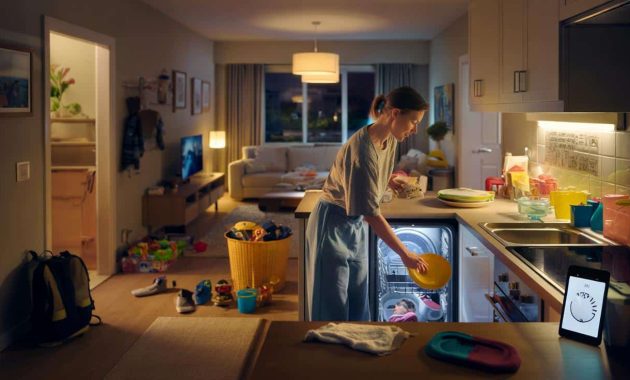
The mugs from last night are still lined up accusingly by the sink. There’s a sock under the coffee table, a backpack exploded in the hallway, and three open to-do lists on the counter. Your calendar looks like a game of Tetris played by someone slightly unhinged. Meetings, kids’ activities, late-night emails. You tell yourself you’ll “catch up on the weekend”, but the weekend arrives already tired. The house never quite hits clean, only “slightly less chaotic than yesterday”.
Still, some people quietly have homes that don’t tip into disaster, even when their week goes sideways. Not magazine-level perfect. Just… under control. The kind of place where you can open the door to a surprise visitor and not die inside.
They’re not doing more. They’re doing one thing differently.
The habit that survives real life
There’s a cleaning habit that works even when your schedule blows up. It isn’t a fancy system, a color-coded app, or a 27-step routine from a productivity guru. It’s boring, almost disappointingly simple: a non-negotiable daily “reset” that happens at the same small window of time, no matter what the day looks like.
Think of it as brushing your teeth for your home. Not deep cleaning. Not decluttering the entire garage. Just a short, repeatable sequence of tiny tasks that bring the chaos back to baseline. Done even when you’re tired, late, or scrolling on the couch pretending you’ll get up “in five minutes”.
Picture this. It’s 10:17 p.m., and Lena is standing in her dim kitchen, phone on the counter, timer set to 12 minutes. Her day was a mess: two kids’ activities back-to-back, a late Zoom meeting, dinner eaten in shifts. She’d love to fall face-first into bed. Instead, she moves like someone on autopilot.
Dishes in the dishwasher. Counters wiped. Toys tossed into one basket. Shoes lined up by the door. A fast sweep of the visible floor. She doesn’t clean the bathroom or fold laundry or reorganize a single drawer. When the timer beeps, she turns out the kitchen light and walks down the hall. The place isn’t spotless. It simply feels reset, like the room took a deep breath.
This habit works because it isn’t tied to having free time. It’s tied to a signal in your day: after the kids are in bed, after you close the laptop, right before you brush your teeth, after the evening show. When life explodes, free time disappears first. Signals don’t.
Your brain loves patterns. When you repeat the same tiny sequence at the same moment, it stops being a choice and starts being a script. That’s the secret. **The less you have to decide, the easier it is to act**, especially when you’re tired. Deep cleaning needs motivation. A daily reset needs only momentum.
How to build a “can’t-break-it” daily reset
Start ridiculously small. Not “clean the kitchen”. That’s vague and, frankly, too big for a day when you ate cereal for dinner. Create a micro-sequence of 4–6 clear actions you can do in 10–15 minutes, tops.
For example: clear and load dishes, wipe the table, wipe counters, do a fast surface pick-up in the living room, take out visible trash. That’s it. Same order every time. Same time anchor every evening, even if it slides by half an hour. Think of it like a tiny script your future self can run while half-asleep.
Most people design their reset around an imaginary version of themselves. That person never gets sick, never works late, never doomscrolls. Reality laughs. Then the routine dies after three ambitious days. Let’s be honest: nobody really does this every single day.
The trick is aiming for “almost always” with a version so small it survives chaos. If you’re exhausted, do the first two steps. If you’re sick, do one thing sitting down, like a quick sofa pick-up. *On the worst days, doing 20% of your reset still protects you from a 200% mess tomorrow.* That’s the math that matters.
“Once I stopped trying to ‘clean the house’ and just did my 10-minute reset, everything changed,” says Ana, a single mom who works shifts. “My place isn’t perfect. But it never scares me anymore.”
That’s the emotional shift this habit creates: your home stops feeling like a judgment and starts feeling like a teammate.
- Anchor it to a real-life cue: after dinner, after kids’ bedtime, or after your nightly show.
- Time-limit it: 10–15 minutes, with a visible timer so there’s an end.
- Keep it visual: focus on what you’ll actually see tomorrow morning.
- Write your steps somewhere obvious until they’re memorized.
- Protect the reset: if you skip, restart the very next day without guilt.
Living in “always almost clean” instead of “always catching up”
There’s a quiet kind of confidence that comes from waking up to a home that doesn’t greet you with yesterday’s chaos. You’re still busy. You’re still juggling. But the floor isn’t a landmine of Lego and wrappers, the sink isn’t a science experiment, and you can make coffee without clearing a space first.
This habit won’t magically organize your attic or fold every sock. It will give you a stable ground floor. When an unexpected free hour appears, you can finally use it for the deeper stuff instead of just putting out fires. That’s the subtle power: your energy stops going into panic-cleaning and starts going into intentional cleaning.
We’ve all been there, that moment when you glance around and think, “How did it get this bad again?” A daily reset doesn’t stop those weeks from happening, but it raises the floor. Your “bad” week might look like last year’s “okay” week. Your recovery time shrinks. You bounce back faster because there’s less to dig out from under.
Over time, this tiny ritual seeps into other things. You start resetting your desk after work, closing browser tabs at the end of the day, doing quick emotional resets after hard conversations. It becomes a quiet declaration: chaos might visit, but it doesn’t live here.
| Key point | Detail | Value for the reader |
|---|---|---|
| Daily reset, not deep clean | Short, repeatable 10–15 minute sequence done at the same time | Feels doable on busy days, so it actually gets done |
| Anchor to a cue, not free time | Linked to bedtime, closing laptop, or post-dinner routine | Survives schedule changes and reduces decision fatigue |
| Lower the bar, protect the floor | Do a tiny version even on bad days, skip guilt, restart next day | Keeps the home from tipping into overwhelming chaos |
FAQ:
- Question 1What if my evenings are unpredictable and I don’t have a set time?
- Answer 1Pick a flexible cue, not a clock time: “after I eat my last meal”, “after the kids’ last activity”, or “right before I brush my teeth”. Your routine might start at 8:30 one night and 10:15 the next, but the signal is the same.
- Question 2How do I handle roommates or family members who don’t help?
- Answer 2Design a reset you can complete solo in 10–15 minutes, then invite others into one tiny shared task, like a two-minute family toy pickup. You can’t control their effort, only your baseline. Often, your visible consistency quietly nudges others over time.
- Question 3Isn’t this just another thing on my already packed to-do list?
- Answer 3It can feel that way at first. The shift comes when you see it not as “extra cleaning” but as trading 10 minutes at night for 30–40 minutes of scrambling tomorrow. The net load drops. Your mornings get lighter, and that pays you back fast.
- Question 4What if my house is already a disaster? Where do I even start a reset?
- Answer 4Choose one zone as your reset stage: often the kitchen or living room. For two weeks, your nightly reset is only that area. Ignore the rest for now. Once that zone feels reliable, you can add a tiny second step elsewhere.
- Question 5How long until this starts to feel automatic?
- Answer 5Most people feel less resistance after about two weeks of “good enough” consistency and notice it becoming semi-automatic around the one-month mark. The key is not perfect streaks, but returning to the habit the very next day after any miss.
➡️ Netflix: one of the greatest action-adventure films ever, you have only 2 days left to watch it
➡️ Superbugs: hospitals roll out rapid DNA tests to prevent a health crisis
➡️ Phone fraud: this new method makes it even easier for criminals
➡️ Goodbye to happiness : the age when it falters, according to science