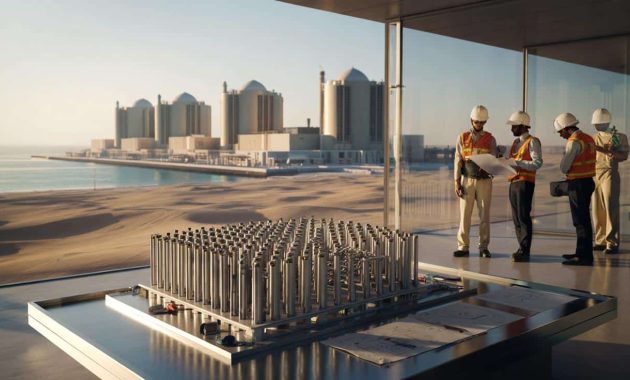
On a remote stretch of coastline in the United Arab Emirates, the Barakah nuclear power plant is quietly reshaping energy politics in the Gulf – and giving France’s nuclear heavyweight Framatome a strategic foothold in the Middle East.
Barakah, a nuclear outpost between dunes and sea
Barakah sits on the western shore of the UAE, far from Dubai’s skyscrapers and Abu Dhabi’s financial district. The site hosts four pressurised water reactors built by a South Korean-led consortium, but its fuel story is increasingly written in French.
The plant already provides around a quarter of the UAE’s electricity, roughly 40 terawatt-hours a year, according to project figures. That power comes with a striking climate twist: no direct CO₂ emissions from generation.
Barakah’s reactors avoid an estimated 22.4 million tonnes of CO₂ a year – similar to taking nearly 5 million conventional cars off the road.
For a petro-state that still earns much of its money from exporting oil and gas, that number matters. It signals to investors and allies that the UAE plans to stay in the energy game long after fossil fuel demand plateaus.
Why a country rich in oil wants nuclear power
From the outside, nuclear in the Gulf can look like a paradox. The UAE sits on vast hydrocarbon reserves and already exports liquefied natural gas and crude oil. Yet the country has three hard-headed reasons to push into atomic energy.
- Freeing up hydrocarbons for export: Using nuclear for domestic power means more oil and gas can be sold abroad.
- Cutting carbon emissions: Nuclear supports the UAE’s pledges on climate and gives it diplomatic leverage in climate talks.
- Energy security: A diversified power mix reduces exposure to volatile gas markets or regional supply shocks.
Barakah has become more than a big engineering project. It acts as a regional showroom for how an Arab state can develop civilian nuclear under tight international supervision, while talking openly about net-zero strategies.
Framatome’s fuel assemblies land in the desert
Into this context steps Framatome, the French nuclear fuel and services group with roots in Europe’s massive atomic fleet. The company has just shipped a first batch of so‑called “lead test assemblies” to Barakah.
These are not standard fuel bundles destined for decades of routine refuelling. They are qualifying prototypes, designed to prove that Framatome’s fuel works safely and efficiently inside Barakah’s Korean-designed reactors.
➡️ An Unusual March Polar Vortex Disruption Is Approaching: And It’s Exceptionally Strong
➡️ If you feel tense before relaxing, psychology explains the nervous system shift
➡️ Psychology reveals why emotional exhaustion often develops gradually
➡️ Hygiene after 65 : not daily, not weekly, here’s the ideal shower frequency for staying healthy
Each prototype fuel assembly is a compact lattice of zirconium alloy tubes filled with uranium pellets, engineered to millimetre tolerances.
The assemblies were manufactured at Framatome’s long-standing plant in Richland, Washington state, which has been churning out nuclear fuel for more than 55 years. The site has repeatedly received top safety ratings from the US Nuclear Regulatory Commission, a selling point for any foreign customer wary of operational risk.
How the fuel qualification process works
Before Barakah’s operator, ENEC, considers large-scale orders, the test assemblies must pass a demanding gauntlet. Engineers subject them to thermal, mechanical and hydraulic tests, both in simulated environments and inside the actual reactors during carefully monitored operating cycles.
They check how the fuel behaves under high temperature and pressure. They assess vibration, corrosion, coolant flow and neutron flux. They track any signs of deformation over months of irradiation.
If performance matches or exceeds existing fuel, ENEC can certify Framatome as a qualified supplier. That would open the way for routine deliveries across all four reactors, locking in a multi-year commercial relationship.
Fuel diversification: a geopolitical safety belt
The UAE’s push to qualify a second fuel supplier is not just a technical exercise. It is a hedge against political and commercial turbulence.
Relying on a single vendor exposes a nuclear operator to supply interruptions linked to sanctions, trade disputes or unexpected technical problems in that vendor’s factories. For a country that increasingly relies on nuclear for base-load electricity, such dependence carries real risk.
Diversifying nuclear fuel sources acts like an insurance policy against future geopolitical shocks.
By bringing in Framatome alongside its original South Korean and US partners, ENEC spreads that risk. It also gains bargaining power when negotiating future contracts, from fuel fabrication to maintenance and upgrades.
From supplier to long-term strategic partner
Framatome is consciously positioning itself as more than a parts vendor. Its teams in Lynchburg, Virginia, are working with Emirati engineers on the technical aspects of fuel design, core management and safety analysis.
This embedded support gives Framatome a chance to influence Barakah’s operating culture over the long haul. It also strengthens the company’s hand when future projects appear in the Gulf region, whether in the UAE or in neighbouring countries watching Barakah closely.
The CEO of Framatome has framed the Barakah milestone as proof of a “solid partnership” with ENEC and shared ambitions around clean energy. Behind the careful corporate language lies a blunt industrial reality: whoever wins fuel contracts wins recurring revenue for decades.
A global client map built over four decades
Barakah is just one tile in a larger mosaic. Framatome has expanded quietly across continents, often acting as a behind-the-scenes specialist rather than the headline reactor builder.
| Country | Main client | Type of work |
| United Arab Emirates | ENEC (Barakah) | Fuel assemblies for PWR reactors |
| China | CGN (Taishan) | EPR fuel and technical services |
| United States | Multiple utilities | Fuel for PWR/BWR, maintenance, engineering |
| South Korea | KHNP | Fuel optimisation and technical cooperation |
| Belgium | Electrabel | Fuel supply and engineering services |
| Finland | TVO | Core modernisation and fuel support |
| Sweden | Vattenfall | Core management and services |
| United Kingdom | EDF Energy | Maintenance and components |
| Czech Republic | ČEZ | Fuel supply and technical assistance |
| South Africa | Eskom | Fuel and operational support |
| Brazil | Eletronuclear | Technical cooperation on fuel |
| India | NPCIL | EPR-related projects under discussion |
This global spread gives Framatome a data advantage. Performance feedback from dozens of reactor types, in varied grids and climates, can be folded back into fuel design for sites like Barakah.
Key concepts behind the Barakah project
What a pressurised water reactor actually does
Barakah’s units are pressurised water reactors, often abbreviated as PWRs. In simple terms, high-pressure water circles through the reactor core, where uranium atoms split and release heat. That heat is then transferred to a second water loop, which turns to steam and drives a turbine.
The key feature is that the primary water loop remains liquid under high pressure and never boils. This design separates radioactive water from the steam that reaches the turbine, which sits in a conventional-looking power island.
Why fuel assemblies matter more than they look
From the outside, a fuel assembly resembles a rigid metal cage filled with long, thin rods. Each rod contains stacked uranium pellets about the size of a fingertip. Yet within that unassuming geometry lies the heart of the plant’s performance and safety.
The arrangement of rods, the composition of the uranium, and the materials used for cladding all influence how the reactor behaves under normal running, during power changes and in off-normal conditions. A small design tweak can raise efficiency or extend fuel cycles by months, which translates into millions of dollars over the life of a plant.
Risks, benefits and long-term questions
For the UAE, nuclear brings benefits and trade-offs that go beyond clean power statistics. The country gains a stable, climate-friendly source of electricity well suited for energy-intensive air conditioning and desalination. It also acquires a complex industrial ecosystem that demands high skills and strict regulatory discipline.
On the risk side, the UAE must manage spent fuel for decades, guard its facilities against cyber and physical threats, and maintain public trust in the safety of a technology many residents only know from past accidents abroad. Partnerships with established players such as Framatome help, but they do not erase the need for a robust local safety culture.
Barakah also raises a regional question: if nuclear works technically and politically in the UAE, which neighbour steps up next? Saudi Arabia has long signalled interest. Egypt and Turkey already have their own projects, supported by Russia. In that context, every successful fuel delivery to Barakah doubles as a discreet commercial pitch for future contracts across the wider Middle East.