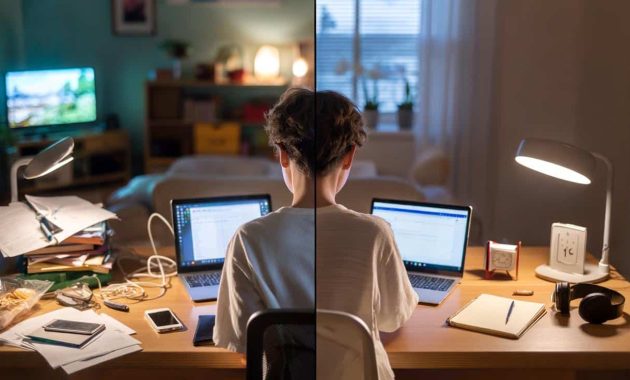
You sit down, ready to finally tackle that big task. Five minutes later, you’re scrolling on your phone, rearranging pens, re-reading a random email from three months ago. The work is still there, untouched, staring back at you.
You tell yourself you’re lazy, or weak, or “bad at focus”. Yet as your eyes wander around the room, something else is going on. The pile of laundry, the open tabs, the chat notifications, the TV in the next room, the half-finished puzzle on the table. All these tiny signals are whispering: “Do something else.”
What if procrastination wasn’t only in your head, but also in your walls, your desk and your screen?
The invisible grip of your surroundings
Look around the place where you usually procrastinate. It’s rarely neutral. There’s the chair that hurts your back after ten minutes. The desk where receipts, chargers and half-read books are fighting for space. The window where neighbours’ lives seem far more interesting than your spreadsheets.
Your environment is constantly negotiating with your attention. A bright notification bubble, a stack of unopened mail, a gaming console in your peripheral vision. None of these things scream loudly. They just keep tapping you on the shoulder, again and again, until your focus gives up.
We like to believe we have strong willpower. Yet most days, the room wins.
A psychologist once filmed people working in different rooms: one minimal, one chaotic, one cosy with a visible TV. The tasks were the same, the people were similar. The results weren’t. In the cluttered room, people switched tasks more often and finished less. In the cosy-TV room, they started fast… then drifted off and took longer breaks.
On a university campus, a small lab changed just one thing: the position of phones. In one group, phones stayed on desks. In another, they were kept in bags, out of sight. The group with visible phones performed worse on attention tests, even when the phones were silent. Not touched. Just there, like a quiet third person in the room.
We’re used to blaming social media or deadlines. Yet the angle of a chair, the height of a screen, the presence of a snack drawer, all these shape whether we slide into work or into delay. The environment makes some choices effortless, and others strangely heavy.
There’s a reason airports flood your path with shops, signs and bright screens. They know attention is physical before it is mental.
➡️ Satellites have detected colossal 35 metre waves linked to unexplained deep-ocean seismic activity
➡️ Under Antarctica there is a hidden world
➡️ This country could face a historic winter due to a rare mix of La Niña and the polar vortex
➡️ Meteorologists warn early March may bring Arctic conditions impacting animal navigation and survival
Procrastination often feels like a character flaw. In reality, it’s frequently a design flaw. Environments are full of “friction points”: objects or cues that make starting just a little harder. Every extra step counts. If you have to dig through three drawers to find your notebook, your brain is already bargaining for an easier task.
On the flip side, there are “slide points”: tiny nudges that make the wanted action smoother. A notebook already open at the right page. A single pen in the middle of an empty desk. A document pinned to your desktop instead of buried in six folders. Your brain is wired to choose the path that feels lighter at that precise moment.
Put simply: your surroundings are constantly voting for “now” or “later”. And they vote with objects, not speeches.
Designing a space that makes starting almost automatic
One of the most effective anti-procrastination moves is not a new app, but a small, physical reset. Choose a single spot where “work happens”, even if it’s just one side of your kitchen table. Then strip it down. Remove everything that doesn’t help with the next task you want to do.
Next, add one strong cue for starting. That might be a specific lamp you only turn on when you work. A pair of headphones you only wear during deep tasks. A simple timer sitting in front of you. Your brain learns fast: “When this light is on, we begin.”
Make the first action ridiculously easy. Not “write the report”, but “open the document and write one messy sentence”. Lowering the threshold is not childish, it’s strategic.
It helps to treat environmental changes like tiny experiments. For one week, hide your phone in a different room during your main work block. For another week, work only with one browser tab open. Change the angle of your desk so you don’t face the TV. Notice how your urge to “just check something” changes.
On a more emotional level, create a small ritual around starting. Light a candle, play the same instrumental track, or drink your coffee only when the first five minutes are done. These aren’t productivity hacks; they’re anchors. They tell your nervous system, *this is safe, this is known, we’ve done this before*.
On a bad day, you may still drift. That’s fine. The point is to make drifting the exception, not the default. Environment is about odds, not perfection.
A lot of people sabotage themselves by building a “perfect” workspace that they never actually use. They buy a fancy chair, a new monitor, three different planners. Then they go back to working on the sofa in front of Netflix. The gap between intention and reality starts in the room.
Soyons honnêtes : personne ne fait vraiment ça tous les jours. No one resets their desk like an Instagram reel every evening. You’re busy. You’re tired. You live with other humans who also have stuff and noise and mess. That’s normal.
What you can do, though, is choose one friction point at a time. Is it the phone on the desk? The TV visible from your laptop? The pile of “I’ll deal with it later” papers in your field of vision? Remove or move just one of these, and see what changes. Sometimes the smallest shift unlocks the biggest task.
“We overestimate our self-control and underestimate the power of the nearest object.”
Your environment toolkit can stay simple:
- One clear “work zone”, however tiny
- One ritual that signals “we’re starting now”
- One rule for your phone during deep work
- One daily micro-reset (30 seconds to clear the surface)
- One safe place for distractions (a notebook to park ideas, urges, reminders)
That’s already more structure than most people have.
Let your surroundings do some of the heavy lifting
On a quiet evening, notice what your environment is silently telling you to do. The book left open on the sofa suggests reading. The remote on the table suggests watching. The running shoes by the door suggest moving. None of this is neutral.
Imagine if your desk whispered “start small” every time you sat down. Imagine if your room made the hard thing feel 10% lighter and the easy distraction 10% heavier. Not dramatically, just enough for you to lean in the right direction. That’s the subtle power of environmental design.
One day, you might catch yourself starting a dreaded task almost on autopilot, without the usual internal fight. The lighting is right, the desk is clear, the phone is out of reach, the ritual has begun. No big speech, no heroic motivation. Just a quiet click into motion.
We rarely talk about procrastination this way. We shame the person, not the place. Yet the place is often easier to change than the person. Shift a lamp, move a chair, hide a device, create a tiny island of focus in the middle of real life chaos. On a bad day, that island is what keeps you from drifting too far.
And once you’ve felt how a small tweak in your surroundings can change your behaviour, it’s hard to unsee it. You start re-reading your own space like a story about what you truly end up doing, when nobody is watching.
| Point clé | Détail | Intérêt pour le lecteur |
|---|---|---|
| Environnement = déclencheur | Les objets, la lumière et le bruit orientent votre attention avant même votre volonté consciente. | Comprendre que vous n’êtes pas “cassé”, votre pièce pousse parfois au report. |
| Réduire la friction | Un seul espace de travail clair, un premier geste minuscule, des distractions hors de vue. | Rendre le démarrage si simple qu’il devient presque automatique. |
| Rituels et signaux | Une lumière, un son, un objet dédiés au moment de concentration. | Créer une réponse conditionnée qui aide le cerveau à entrer plus vite dans la tâche. |
FAQ :
- How does my room actually make me procrastinate?Your brain constantly scans what’s around you for easy rewards. Visible snacks, phones, TVs or open social tabs act like tiny “click me” buttons. Each one pulls a bit of attention until deep work feels heavier than distraction.
- Can changing my environment really beat procrastination?It won’t erase it, but it can reduce it a lot. By removing a few key distractions and adding simple cues to start, you shift the odds. You’ll still have off days, but it’s easier to begin on most days.
- What if I share my space and can’t control the noise or clutter?Work with micro-zones and rituals. Use headphones, a specific chair, or a tray you set up and clear away. Even a small, consistent “focus corner” can help your brain switch modes.
- Is minimalism the only way to avoid procrastination?No. Some people think better with a bit of visual warmth. The key is intentional clutter: things that support your task, not fight it. A busy inspiration wall can help; a busy desk rarely does.
- How do I start if my space is a mess and I feel overwhelmed?Pick a 5-minute target: just clear the area the size of your laptop, nothing else. Then choose one item that will signal “work mode” tomorrow. You’re not redesigning your life, just tilting the room gently in your favour.