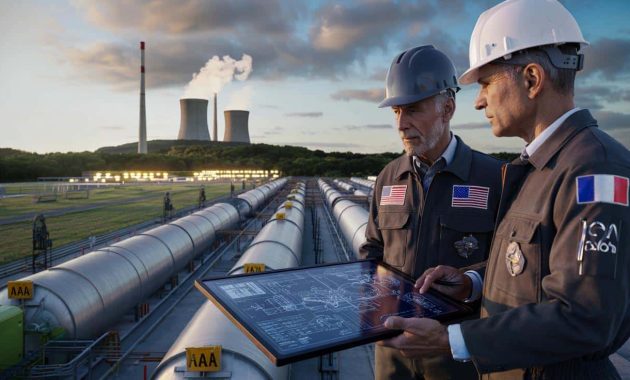
The US government has signed off on a major public funding package for a French-led uranium enrichment plant in Tennessee, signalling a sharp shift away from Russian supplies and a renewed bet on nuclear power as America’s digital appetite explodes.
A $900 million down payment on US nuclear independence
The US Department of Energy (DOE) has approved up to $900 million for French group Orano to launch a new uranium enrichment capacity on American soil. In today’s market, that is roughly $775 million.
This public support is only the visible tip of a far larger industrial iceberg. The complete project around the planned plant in Oak Ridge, Tennessee, is valued at close to $5 billion. Funding will come from a mix of public money, Orano’s balance sheet, and long‑term contracts with utilities.
The US is using French technology to rebuild a strategic nuclear fuel step it had largely let atrophy at home.
For Washington, the move serves several goals at once: cutting reliance on Russian enrichment, shoring up the resilience of its nuclear fleet, and equipping a new generation of reactors planned for grids increasingly strained by data centres and artificial intelligence.
Why uranium enrichment suddenly matters again
Nuclear reactors do not run on raw uranium ore. They need fuel in which the share of the fissile isotope uranium‑235 has been raised through a complex, highly regulated process called enrichment.
This step sits between mining and fuel fabrication. It happens far from the spotlight, but it ultimately determines whether reactors have anything to burn at all.
For decades, the US has relied in part on foreign enrichers, including Russian state company Tenex. That dependence has become politically toxic since Moscow’s invasion of Ukraine and the sharp deterioration in relations with the West.
Congress has already moved. From 2028, US law will ban imports of enriched uranium from Russia, except for rare national‑security waivers. That deadline now hangs over every utility contract and every fuel supply plan.
➡️ New, stricter blood pressure guidelines spark growing concern and debate among cardiologists
➡️ An Unusual March Polar Vortex Disruption Is Approaching: And It’s Exceptionally Strong
The 2028 cut‑off for Russian fuel has turned enrichment capacity from a technical topic into a national security file.
With one main enrichment site currently operating in the country, Urenco USA in New Mexico, Washington needs new capacity on a tight schedule. That sets the stage for the Oak Ridge project.
Project Ike: a symbolic rebirth at Oak Ridge
A name rooted in nuclear history
The new plant carries a loaded name: Project Ike, a nod to Dwight D. Eisenhower and his 1953 “Atoms for Peace” speech at the United Nations. That address framed civilian nuclear power as a tool for prosperity rather than only for bombs.
By choosing that reference, US officials and Orano are sending a message. The aim is to rebuild a full civil nuclear fuel cycle on American soil, from uranium conversion and enrichment all the way to electrons on the grid.
Why Oak Ridge matters
Oak Ridge is not just a random industrial site. Born in the Manhattan Project, it became one of the cradles of the American nuclear programme. The region now hosts a dense cluster of laboratories, regulators, and suppliers.
Orano plans to deploy its gas centrifuge technology there, the same family of machines used at the Georges Besse II plant in France. Centrifuges spin uranium hexafluoride gas at high speed, gradually separating the slightly lighter U‑235 from U‑238.
The process offers better energy efficiency than the older gaseous diffusion method once used in the US, at plants such as Paducah and Portsmouth. For a power system under pressure from rising electricity demand, every saved megawatt counts.
A tight regulatory and industrial timetable
The DOE’s decision does not mean shovels hit the ground tomorrow. It opens a defined sequence of regulatory and contractual steps.
During the first half of 2026, Orano expects to finalise its agreement with the DOE and formally submit its licence application to the Nuclear Regulatory Commission (NRC). That file will cover safety, non‑proliferation guarantees, environmental impact and long‑term waste management.
Licensing of fuel cycle facilities in the US has a reputation for being demanding and meticulous. The Trump administration already moved to streamline parts of the NRC’s process in 2025, putting the agency under more direct political steering for some advanced projects. Even so, enrichment remains one of the most tightly supervised activities in the nuclear chain.
The target is to begin production early in the next decade, then ramp up gradually. Capacity will be tailored to the needs of both today’s large reactors and tomorrow’s small modular reactors (SMRs), which often require slightly different fuel specifications.
Existing US enrichment landscape
For now, US enrichment remains thinly spread. Oak Ridge would join a short list of key sites:
| Site / plant | State | Main status | Main technology |
| Urenco USA (Eunice) | New Mexico | Operating; main commercial supplier | Gas centrifuge |
| Portsmouth Gaseous Diffusion Plant | Ohio | Shut down; undergoing cleanup | Historic gaseous diffusion |
| Paducah Gaseous Diffusion Plant | Kentucky | Shut down; storage and remediation | Historic gaseous diffusion |
| Oak Ridge Y‑12 (Centrus Energy) | Tennessee | HALEU demonstrator in operation | Advanced centrifuge |
| American Centrifuge Plant (Piketon) | Ohio | Project under development | Gas centrifuge |
In that landscape, Ike would stand out as a large‑scale, export‑grade plant, marrying European know‑how with US regulatory control.
Nuclear’s comeback ride on the AI and data‑centre boom
The Oak Ridge project is not just a response to sanctions on Russia. It fits into a broader US energy puzzle driven by the rise of digital infrastructure.
Data centres for cloud computing, video streaming and AI require stable power around the clock. They do not tolerate voltage swings or long outages. At the same time, many US states are trying to cut emissions and retire coal plants.
The surge in AI workloads gives nuclear a new role: a quiet, predictable backbone behind the noisy cloud.
Gas‑fired plants can fill some of that gap, but fuel price volatility and climate targets limit their appeal. Wind and solar continue to expand, yet their variability creates problems when servers run 24/7.
Nuclear offers something different: large volumes of low‑carbon, dispatchable electricity with a small land footprint. Under Trump’s second term, the White House has openly embraced that logic. A 2025 presidential order simplified certain licensing steps for micro‑reactors and advanced designs serving defence and critical infrastructure.
The goal is ambitious: multiply installed nuclear capacity by a factor of four over the long term, driven by SMRs and advanced reactors that can power isolated military bases, industrial clusters or energy‑hungry data hubs.
In that scenario, domestic enrichment capacity becomes more than a back‑office process. It turns into a bottleneck that can either slow or enable America’s nuclear resurgence.
Orano’s long game from Cogema to strategic linchpin
For Orano, the US funding crowns nearly fifty years of slow, technical work that began when France created state company Cogema in 1976 to control its nuclear fuel.
Rebranded as Orano in 2018, the group weathered political swings over nuclear energy, financial crises and competition from cheaper Russian fuel. Through all that, it kept investing in centrifuge technology, uranium conversion and fuel logistics.
Today, around 16,500 people work for Orano worldwide. Its flagship enrichment plant at Tricastin, in southern France, supplies fuel for more than 30 countries, from Europe to Asia and the Middle East.
The Oak Ridge contract shifts the group into a different league. Orano moves from reliable European supplier to cornerstone of Western energy security, operating under US federal oversight in an area that touches both electricity markets and geopolitical balance.
With Oak Ridge, Orano becomes one of the few companies trusted on both sides of the Atlantic to handle enrichment at industrial scale.
What uranium enrichment actually entails
Enrichment often sounds abstract, so it helps to break down the basics.
- Natural uranium contains about 0.7% uranium‑235, the fissile isotope.
- Most power reactors need fuel enriched to around 3–5% U‑235, called low‑enriched uranium (LEU).
- Advanced reactors and some research units may use higher levels, known as HALEU (high‑assay LEU), typically between 5% and 20%.
- Weapons‑grade uranium, by contrast, exceeds 90% U‑235, a level strictly banned for civilian programmes.
Centrifuge cascades perform thousands of tiny separations. The key challenge lies in controlling that process with extreme precision, so that the final product matches the exact enrichment level each reactor design demands, without crossing legal and treaty limits.
On top of that, operators must handle uranium hexafluoride, a corrosive gas, under strict safety and environmental rules, and track every movement of material to comply with non‑proliferation agreements.
Risks, benefits and the next set of questions
Bringing a foreign player into such a sensitive sector carries both advantages and points of friction for Washington.
On the plus side, Orano brings a technology that has already run at full industrial scale for decades, with a proven safety record. That cuts development risk, and allows the US to move faster than if it tried to reinvent a large centrifuge fleet alone.
At the same time, the US will want to ensure strict control over export licences, know‑how transfer and the ultimate destination of enriched material. Contracts and governance structures will need to spell out who decides what during crises, supply shocks or political disputes.
For local communities in Tennessee and for unions like the United Steelworkers, the plant also raises more concrete questions: how many long‑term jobs, what training, what level of federal support for site cleanup at the end of the facility’s life, and what emergency plans in case of accidents.
If the Oak Ridge project runs on schedule and on budget, it could set a template for other transatlantic nuclear deals: European technology, American regulatory control, and shared strategic goals, from cutting emissions to reducing dependence on Russia and China for critical energy infrastructure.