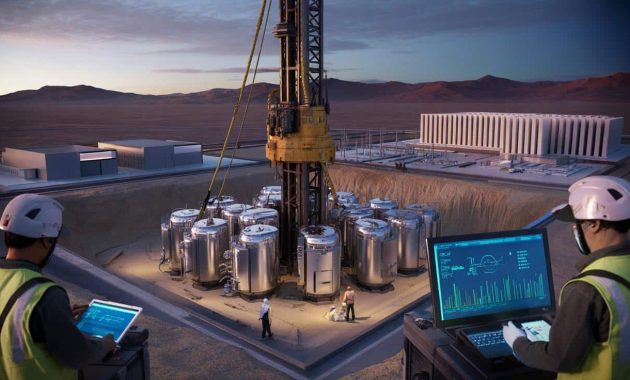
In the high desert of Idaho and in a pilot factory in Texas, a small US startup is trying to prove that nuclear power can be manufactured, shipped and plugged in almost like industrial hardware. Its bet: an “extra‑modular” reactor that trades gigantism for speed, flexibility and deep underground installation.
A reactor concept built for factories, not construction sites
On 21 December 2025, Austin-based Aalo Atomics shipped five modules of its extra‑modular reactor, known as XMR or Aalo‑X, to Idaho National Laboratory (INL). The units left the company’s pilot plant without nuclear fuel on board. They will first serve for integrated non-nuclear tests: steam production, heat transfer and checks on the behaviour of the overall system.
Aalo’s goal is to reach first nuclear criticality in 2026 and prove that a factory-built reactor can move from concept to real power in just a few years.
The company calls its design “extra‑modular” to signal a break from classic small modular reactors (SMRs). Traditional SMRs still resemble shrunken versions of big plants, often sized around 300 megawatts. Aalo’s reactor takes the opposite route: many small, repeatable blocks aggregated on demand.
The logic behind “extra‑modularity”
A single Aalo‑X reactor is modest in power. Five of them combine into what the company calls an Aalo Pod, delivering around 50 MW of electricity. That output targets energy‑hungry users that want dedicated, local supply:
- Large data centers and cloud campuses
- Digital platforms that need 24/7 power
- Industrial sites far from robust grids
- Critical infrastructure such as desalination or defense facilities
The strategy is industrial more than marketing. By keeping each block identical and compact, Aalo can treat reactors less like one‑off megaprojects and more like a product line. The company wants to assemble and test each module inside a factory, only shipping hardware that has already passed performance checks.
The promise: scale by replication rather than by building ever larger plants, and tune power output simply by adding or removing modules.
This approach also tackles a chronic problem in nuclear: over‑sizing. Rather than designing a 1 GW unit and then hoping demand or grid capacity catches up, a customer could start with a few pods and expand in steps, much as server capacity grows in a data center.
Why this reactor abandons water for liquid sodium
The other key choice is the coolant. Instead of high‑pressure water, Aalo’s reactor uses liquid sodium, a technology that belongs to Generation IV fast reactors and that has already seen large‑scale experiments, such as France’s Superphénix.
➡️ This country could face a historic winter due to a rare mix of La Niña and the polar vortex
➡️ What it really means when someone walks ahead of you, according to psychology
➡️ The neighbour who reported an illegal electrical hookup saw inspectors arrive the very next day
Two main advantages of sodium cooling
- Sodium stays liquid at high temperature under low pressure. That removes the need for huge pressure vessels and thick containment structures designed to hold water at dozens of bars.
- The reactor can run at higher temperatures in a compact core. That boosts thermal efficiency and makes it easier to build standardized modules that fit into conventional transport logistics.
For an industrial client, higher outlet temperatures matter. They mean more electricity per unit of fuel, but also the potential to provide process heat directly for chemicals, steel or hydrogen production, without an intermediate boiler system.
Sodium does bring constraints: it reacts aggressively with water and air, and operators must design circuits and maintenance procedures that keep the metal isolated. The benefit is a system that works at near‑atmospheric pressure, which simplifies much of the mechanical engineering.
Deep underground: borrowing tools from the oil patch
Aalo’s concept does not stop at the reactor vessel. The company wants to change how nuclear plants sit in the landscape. Instead of wide concrete basements and cooling towers, the design pushes much of the nuclear island deep underground.
US plans for very deep siting, down to around 1,600 meters below ground, rely on geological pressure and stable rock to add layers of physical safety.
To reach those depths, Aalo borrows techniques from the oil and gas sector. It uses vertical drilling instead of classical excavation or blasting. According to internal estimates, this method can:
- Cut excavation time by about half
- Reduce noise and surface disruption near sensitive sites
- Produce straight, accurate shafts sized for pre‑fabricated reactor pods
By housing reactors in narrow, deep shafts, the company hopes to reduce land use, limit visual impact and add a natural buffer around the core. Surrounding rock can help contain pressure waves or debris in improbable accident scenarios, while also offering protection against external threats.
A direct heir of federal micro‑reactor programs
From MARVEL to Aalo‑X
The technical DNA of Aalo‑X traces back to MARVEL, a micro‑reactor project led by the US Department of Energy to test very small, advanced nuclear systems. Aalo’s chief technology officer, Yasir Arafat, played a central role in MARVEL, and several design ideas transitioned directly to the startup.
Key inherited features include:
- A metal hydride fuel matrix, which runs at low pressure and couples the fuel’s physical expansion to the reactor’s neutron behaviour.
- Passive safety mechanisms: as temperature rises or power surges, the fuel expands slightly, making the chain reaction less efficient and slowing the reactor without operator intervention.
- A simplified architecture with fewer active components such as pumps or motor‑driven valves.
The philosophy centres on physics rather than layers of external systems. Instead of relying primarily on diesel generators, control electronics and complex procedures, the core itself responds to abnormal conditions by drifting toward a safer state.
Regulation, artificial intelligence and political timing
Aalo’s fast timeline aligns with a political push. A presidential order signed in June 2025 encouraged testing of advanced reactors on federal sites and adjusted some licensing steps, especially for demonstration projects at national laboratories like INL.
At the same time, the company has entered into a partnership with Microsoft focused on artificial intelligence tools for navigating regulation. The idea is to feed thousands of pages of nuclear standards, environmental rules and safety guides into AI agents that then generate structured workflows, checklists and draft documentation for engineers and legal teams.
Instead of skipping rules, Aalo wants to turn regulatory text into something closer to software: queryable, testable and less dependent on manual cross‑checking.
If the schedule holds, Aalo aims to move from company founding to first fission in record time, and not stop at a barely‑useful demonstrator. The plan is to link a pod to a live data center, showing not just that the reactor runs, but that it can anchor a modern digital facility.
How Aalo fits into the new nuclear ecosystem
Not a rival to big national reactors
Aalo does not try to replace large gigawatt‑scale reactors that feed national grids. Those projects serve regions or entire countries. Instead, the extra‑modular concept targets a different segment: local, controllable, low‑carbon power where grid reinforcement would be slow or costly.
If Aalo‑X reaches first criticality at INL in 2026 and performs as expected, the main questions will shift from physics to economics:
- How cheap can manufacturing become once a stable design locks in?
- What price per megawatt will customers accept for 24/7 on‑site power?
- How will insurance and financing react to underground, modular nuclear assets?
How it compares to other advanced SMR concepts
The extra‑modular sodium‑cooled reactor sits alongside a wider set of Generation IV designs, each trying to solve a slightly different problem. Here is a quick comparison of major SMR families mentioned by nuclear researchers:
| SMR technology | Coolant | Fuel | Main strengths | Maturity |
| Fast neutron SMR | Liquid sodium | Uranium or MOX | Better fuel use, less long‑lived waste | Past demonstrators, new projects underway |
| Molten salt SMR (MSR) | Molten salt | Uranium or thorium in solution | Low pressure, passive behaviour, flexible fuel cycles | Advanced R&D, prototypes planned |
| HTGR‑type gas SMR | Helium | TRISO fuel particles | Very high temperature, useful for industry and hydrogen | Pilot plants and demos |
| Lead or lead‑bismuth SMR | Lead / Pb‑Bi | Uranium | Strong radiation resistance, compact cores | Pre‑industrial development |
| Advanced light‑water SMR | Pressurized water | Uranium | Continuity with today’s reactors, faster deployment | Closest to commercial rollout |
Aalo’s extra‑modular architecture could, in theory, host different coolants or fuels in the long run, as long as the physical constraints match the shaft and pod design. For now, sodium fast reactors give the company a technology with decades of experimental history and plenty of existing research to build on.
Risks, challenges and what comes next
The main technical risk remains integration. Each piece of the reactor — sodium circuits, fuel elements, passive safety, underground siting — has seen testing in other contexts. The challenge lies in combining them into a system that regulators, local communities and insurers all accept.
Sodium handling will likely attract scrutiny. Fire brigades and emergency planners will ask how to manage leaks or contact with water. Aalo will need clear, credible procedures and physical barriers that convince both experts and the public.
The economic risk is just as real. Factory production only pays off if orders reach a certain volume. A handful of pods for data centers will not justify dedicated manufacturing lines. That means Aalo must sign early anchor customers while also surviving a long and expensive licensing process.
Still, the concept points to a different way of thinking about nuclear energy. Instead of a few monumental plants, a country could host a mesh of small, standardised, underground reactors directly tied to industrial clusters, ports or digital hubs. Each unit would add capacity incrementally, and decommissioning would resemble the retirement of a well rather than dismantling a sprawling site.
For readers who want to follow the next steps, two milestones stand out: the non‑nuclear tests at INL in the coming months, which will validate thermal performance, and the first fuel loading campaign, which will measure how easily an extra‑modular plant can shift from lab curiosity to working asset. Those results will influence not just Aalo’s future, but also how investors judge the broader promise of factory‑built nuclear reactors.