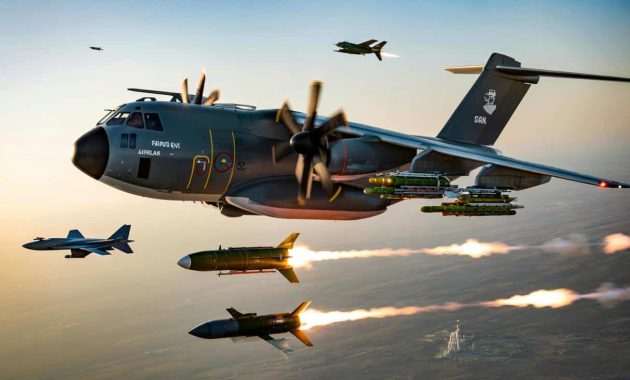
Now French planners are quietly eyeing a far more aggressive mission.
The A400M Atlas, a workhorse of the French Air and Space Force, is being studied not just as a transporter but as a future strike platform, able to carry missiles, guided bombs and even advanced energy weapons deep into contested airspace.
From heavy hauler to front-line strike platform
Built by Airbus, the A400M is normally the anonymous giant in the background of operations: a 141‑ton aircraft ferrying vehicles, ammunition and soldiers. It was designed to replace ageing C-160 Transalls and complement US-made C-130s, not to hunt enemy radars or punch holes in sophisticated air defences.
French defence planners now want to squeeze much more value out of each aircraft. Instead of flying in only after air superiority has been secured, the Atlas could become part of the first wave.
The French government is studying ways to arm the A400M with precision missiles and guided bombs, turning a logistical asset into a long-range strike tool.
The core idea is simple: use the aircraft’s huge internal volume, strong wings and powerful electrical systems as a flexible backbone. Weapons could be carried inside the cargo hold on modular racks, or mounted externally under the wings or fuselage. With that, a single A400M could potentially release dozens of stand‑off munitions in one sortie.
What the A400M already brings to the fight
The A400M is not starting from zero. Its baseline performance already gives it reach and resilience that traditional bombers or fighters struggle to match on logistics missions.
| Specification | Value |
| Maximum payload | 35,000 kg |
| Range without refuelling | 9,000 km |
| Cruise speed | Mach 0.68–0.72 |
| Internal fuel capacity | 50,000 kg |
| Troop capacity | Up to 116 paratroopers |
| Typical equipment load | 2 Tiger helicopters or 2 armoured vehicles (VAB) |
| Cargo hold volume | 340 m³ |
Its four TP400 turboprop engines, each producing around 11,600 horsepower, allow operations from short, rough airstrips while still lifting a sizeable load. The aircraft can fly at very low altitude on automatic modes, including in poor visibility, which is crucial for sneaking under radar coverage or serving front-line bases.
The power generation onboard is also substantial. That matters for any future “high-energy” weapons, like directed-energy pods, jamming systems or advanced radar and sensor suites that need lots of electricity.
The A400M combines heavy-lift capability with long range and rough-field performance — traits that make it an unusual but attractive candidate for a strike conversion.
➡️ The plant that perfumes the home and repels mosquitoes : here’s why everyone wants it in spring
➡️ Nancy Guthrie live updates: DNA from someone other than Guthrie was collected from her property
➡️ Marine researchers spot glowing organisms deeper than any camera has gone before
➡️ I haven’t used a compost bin since learning this technique – and my garden has never looked better
➡️ Martin Lewis settles your heating dilemma: leave it on low all day or not? 7 tips and £1,755 hit
Turning a transport into a missile truck
French officers working on future capabilities have floated a clear ambition: use the A400M as a “mass strike” platform. Instead of depending entirely on a small fleet of expensive fighters to fire a handful of cruise missiles, a modified Atlas could deploy a dense salvo of weapons in one go.
How the weapons could be integrated
Several options are on the table for the aircraft’s transformation:
- Internal racks: pallets or modular frames in the cargo bay holding cruise missiles or glide bombs, released through the rear ramp or side doors.
- Underwing pylons: hardpoints mounted under the wings to carry stand‑off weapons such as anti-ship or land‑attack missiles.
- Smart dispensers: “missile container” systems that drop from the aircraft and then release swarms of smaller drones or loitering munitions.
- Sensor pods: targeting and reconnaissance pods for locating, identifying and tracking targets from long range.
In missions aimed at Suppression of Enemy Air Defences (SEAD), the aircraft could fire a wave of anti‑radiation missiles at radars, coordinate with drones, and then turn back before entering the most heavily defended zones.
France is not alone in thinking this way
This trend is not specifically French. Japan has been assessing similar concepts around its Kawasaki C‑2 transport aircraft. Tokyo is looking at arming it with weapons like the Type 12 surface‑to‑ship missile and US-made AGM‑158 JASSM cruise missiles.
The logic is strategic and shared: transport aircraft expose a new kind of threat to adversaries. An enemy that once ignored lumbering transports as “rear-area” assets would now need to account for their possible role as flying missile batteries.
Converting transports into offensive platforms allows air forces to increase strike mass without buying entirely new bombers.
Bridging the gap between fighters and drones
Modern warfare puts pressure on numbers. High-end fighter jets are expensive to buy, crew and maintain. Drones are cheaper and disposable but often carry fewer or lighter munitions, and remain vulnerable to jamming and air defences.
A weaponised A400M sits in the middle. It is slower and larger than a fighter, so it must rely on stand‑off weapons and careful planning. Yet it can carry far more payload than a squadron of drones and at lower cost than building a fresh generation of dedicated bombers.
Technology foundations France already has
French forces experimented with some of these ideas long before the A400M arrived. On the older C‑160 Transall, the C3ISTAR system allowed crews to perform surveillance, identify targets and help guide munitions launched by other platforms. That project showed that transport aircraft can act as more than “flying trucks”.
More recently, the NITRATHE project, led by French firm Turgis & Gaillard, has targeted the A400M itself. The aim: a multifunction pod that can manage target designation, intelligence gathering and secure data transmission. That sort of package would be a natural companion to weapon modules, giving the Atlas its own sensors and digital links to fighters, drones and command centres.
Industrial stakes and tight timelines
The French A400M fleet is based primarily at Orléans-Bricy air base, where tactical demonstrations already highlight its abilities in parachute drops and aerial refuelling. Aircraft delivered since 2022 arrive with the final tactical configuration, including automatic parachute modes and the ability to refuel helicopters in flight.
France currently operates around 21 A400Ms and plans to reach 37 aircraft by 2030. Discussions occasionally surface in Paris about acquiring up to 18 extra units in the longer term to fully replace C‑130 Hercules aircraft. Any strike conversion project would plug directly into that industrial timeline, giving Airbus and partners work for years.
Turning the A400M into a strike platform is as much an industrial and political choice as it is a tactical one.
A shift in doctrine, not just hardware
Arming a transport aircraft is not a simple “add pylons and go” upgrade. It reshapes doctrine and training. Crews used to logistics missions would need new skills in threat assessment, electronic warfare and cooperation with fighters and drones.
The future European air combat system, often grouped under the SCAF (Future Combat Air System) label, is designed around a network of manned and unmanned platforms. A modular A400M, able to act as a sensor hub, refueller, or strike carrier depending on mission kits, fits naturally into that architecture.
Risks and vulnerabilities
There are clear downsides. A 141‑ton propeller-driven aircraft has a large radar signature. It cannot dodge fighters or surface‑to‑air missiles in the way a nimble jet can. The concept only works if the A400M launches weapons from well outside the most dangerous envelopes or under the protection of jamming, decoys and escorts.
There are also legal and strategic questions. Using transports in offensive roles could blur the lines of what counts as a “support” platform under certain treaties or informal norms. Adversaries might treat all transports as high‑priority targets, raising risks for humanitarian or evacuation flights in crises.
What “stand-off” and SEAD actually mean
Two terms often appear in discussions of a weaponised A400M: stand‑off and SEAD.
Stand‑off weapons are munitions launched from a safe distance, often hundreds of kilometres away from the target. Cruise missiles and long‑range glide bombs fall into this category. They allow a slow, large platform to strike without overflying heavily defended territory.
SEAD (Suppression of Enemy Air Defences) refers to operations aimed at blinding or destroying enemy radars, surface‑to‑air missile sites and command nodes. A “missile truck” A400M could contribute by launching waves of anti‑radiation missiles guided by its own sensors or those of allied jets and drones.
How such an aircraft might be used in real operations
Imagine a crisis on NATO’s eastern flank. Before any large-scale ground move, allied aircraft need to punch corridors through layered air defences. A formation of fighters and drones flies forward, locating enemy radars and command posts.
Several hundred kilometres behind, a pair of modified A400Ms orbit in relative safety. Once the targets are confirmed, they release dozens of stand‑off missiles from internal racks and wing pylons. The missiles streak ahead at low level, using terrain and jamming for cover. The A400Ms turn away and return to base to reload for a follow‑on wave.
In another scenario, the same aircraft might spend most of its time in its traditional role, carrying troops and vehicles. Only when tensions spike would ground crews bolt on weapons kits and sensor pods, turning a logistic asset into a strike asset within days. That modularity sits at the heart of the French thinking: a single aircraft type filling many roles without a full rebuild.