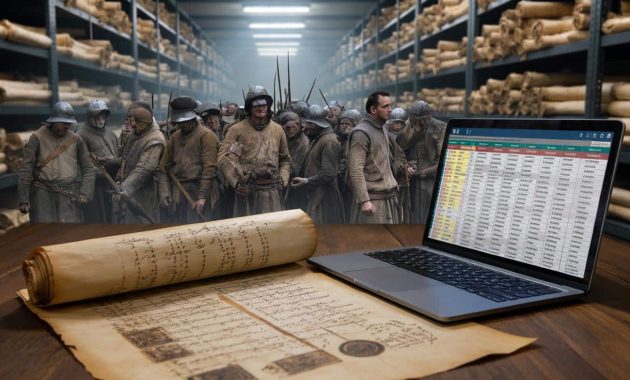
The archive room is colder than it should be. That particular kind of chill that smells of dust, old glue, and someone else’s handwriting. A researcher flips through a parchment roll, lips silently mouthing unfamiliar names: “Robert de Hales… William Bowet… arrows, 120… paid 3 pence… exempted from service.”
On the table, a laptop glows with something stranger than any illuminated manuscript: a massive online database of English military records from the Middle Ages. Thousands of lines. Names, wages, horses, arrows, ships. Ordinary men who somehow slipped through time because a clerk was doing his job.
They weren’t all knights in shining armour.
Some were just tired men counting arrows in the rain.
This isn’t fantasy: one database is rewriting the daily life of medieval soldiers
When most of us picture an English soldier in the Middle Ages, the image is almost scripted. A gleaming knight thundering across a muddy field, banners flying, a kind of live-action version of a school textbook illustration. It feels cinematic, familiar, almost comforting in its simplicity.
Then you scroll through The Soldier in Later Medieval England database, and the illusion starts to crack.
Suddenly there are archers who never saw a charging knight up close, men hired to bring spare bows, carpenters on campaign, Welsh spearmen who deserted before pay day. The war machine looks less like a legend and more like a messy spreadsheet of side jobs and small fears.
Take August 1415, the month we all associate with Agincourt. On the database, it’s not a heroic blur. It’s a pile of pay records, muster rolls, and shipping lists.
You can follow one man, say, John atte Wode, archer in the retinue of an earl. He signs up in Southampton, gets a standard wage, is supposed to serve for several months. The roll notes his equipment. The next entry shows he’s paid a fraction of what the veterans receive. Then another line: someone else, same retinue, fined for failing to appear. The campaign shrinks into a series of personal choices, broken contracts, and sore backs.
Agincourt becomes a lot of waiting around, a lot of walking, and one terrifying day in a muddy field.
➡️ Food experts explain why this cooking shortcut often backfires
➡️ “I felt mentally tired, not physically”: how that still affected my body
➡️ New US Navy missile to support hypersonic strike, air defense roles
➡️ I always prep this winter dish in advance so I can relax in the evening – and it’s a real hit
Historians built this database by combing through royal payment records between 1369 and 1453, a period that spans the Hundred Years’ War, internal rebellions, and endless “small” expeditions. The Crown was obsessed with money and accountability, which turned out to be a gift to anyone curious centuries later.
Every time a captain was paid to raise troops, a clerk wrote it down: names, ranks, how long they served, when they embarked, when they came back, sometimes if they died. Stitch those entries together and a pattern emerges.
English soldiers didn’t live in an endless battlefield. They slipped in and out of war between harvests, city jobs, and family lives. War was a contract, not a destiny.
How the database actually works – and how it quietly humanises the “medieval soldier”
The method behind this big digital beast is surprisingly simple: follow the money. The project team pulled together muster rolls, issue rolls, and pay records sitting quietly in The National Archives at Kew. Then they indexed every soldier who appears, recording things like name, role, captain, theatre of war, and length of service.
On the front end, you just type a name, a year, or a campaign. In a few clicks, the soldier who once existed only in cramped medieval handwriting turns up as a clean, searchable entry. You can filter by archers, men-at-arms, captains. You can jump from a man serving in Gascony in 1370 to another slogging through Normandy in the 1420s.
It’s not flashy. It’s just precise. And that’s what makes it weirdly moving.
You can feel this precision in the tiny stories hidden between the lines. Search for Henry V’s 1415 campaign and thousands of archers appear, most of them anonymous to any chronicle. Some served only that campaign, like seasonal workers. Others would turn up again in later years, climbing the ranks, moving between captains.
There’s the man whose service ends abruptly with a note that he died overseas. Another who switches captains, presumably chasing better pay or better prospects. One soldier appears in the rolls for decades, his wage rising bit by bit, a long career of mud and marches and cold French fields.
These aren’t just units; they’re careers, temp contracts, and quiet personal gambles.
Patterns emerge if you zoom out. The database shows that archers often outnumbered men-at-arms by three or four to one on many expeditions. That means the famous knight on horseback was heavily outnumbered by guys on foot with longbows and calloused fingers.
You also see how coastal towns like Bristol, Plymouth, and Southampton became revolving doors of military labour. Men signed on for a season, collected their wages, survived or didn’t, and went home. Some names appear only once, like shadows passing in front of a candle. Others show up again and again, sometimes across decades, hinting at a kind of professional soldiering that wasn’t supposed to exist this early.
Let’s be honest: nobody really imagines a medieval soldier refreshing his own version of a job board.
Using this database to look for real people behind the armour
If you’re curious, the most powerful thing you can do with this resource is start small. Pick a single campaign: say, the 1415 expedition or the 1380s raids on northern France. Then type in a common name like “John” or “Thomas” and just scroll. It feels almost voyeuristic, watching anonymous men move from one captain’s retinue to another over the years.
Try tracking one person who appears more than once. Note his changing rank, where he serves, how long he stays. It turns history from a static map into a messy commute. Suddenly the Hundred Years’ War looks like a series of personal decisions, short-term contracts, and moments of “do I sign up again or not?”
Many people come to this kind of database hoping to find a specific ancestor. And yes, sometimes that happens. But most of the time, you won’t get that neat Hollywood-style reveal. You’ll find fragments instead: a man with your surname serving under a lord from your region, a name that looks almost like your great-grandfather’s, a village you know still exists.
There’s a small sting in that, and it’s normal. We live on names; the archive lives on fragments. That said, the disappointment often gives way to something richer: you start to see how people like your family would have moved through this world.
You realise the “average medieval soldier” had as many boring days as he had glorious ones.
Sometimes the most honest part of the past isn’t the big battle, but the tiny line that reads: “received wages for 20 days, then discharged.”
- Follow one soldier
Choose a single name that appears in more than one roll and map out his career. Where does he go, who does he serve under, how long does he last? - Look at one captain’s retinue
Pick a known captain – a famous noble or a lesser-known knight – and study the men under him. Are they mostly from one region? Do some names recur in multiple campaigns? - Compare roles and wages
Check how archers, men-at-arms, and specialists like engineers are paid. What does that say about who took the risk and who got the reward? - Spot the “almost invisible” jobs
Look for clerks, shipmasters, armourers. They remind you that war was also administration, logistics, and heavy lifting. - Match records to real places
Search for villages or towns you know. Suddenly that quiet place on a modern map becomes a source of men for a long-vanished army.
The uncomfortable truth this data forces us to face about war and memory
Spend a little time with this database and the Middle Ages stop feeling distant and theatrical. The numbers are steady, almost boring: so many men here, so many days there, this much pay, this many lost. Then your brain makes an awkward jump. You start seeing these men as young, underfed, probably anxious, arguing about wages and food.
We’ve all been there, that moment when you look at a list of names and realise each one belonged to someone who got hungry, got wet, missed home. That recognition can be unsettling. It pulls the plug on the clean, noble version of medieval warfare we picked up from films and simplified history classes.
The war becomes work. Badly paid, risky, often miserable work.
Once you accept that, today’s world sneaks into the frame whether you want it to or not. Seasonal contracts, short-term deployments, people pulled between family, debt, and promises of pay: it all sounds uncomfortably familiar.
The database doesn’t moralise. It just lays out who served, where, for how long, and at what cost to the royal purse. We bring our own reactions. Some will see strategy and state-building. Others will see exploitation. Many will see both at once.
*The past resists staying neatly in its own century.*
Maybe that’s the real power of this kind of project. Not that it solves some big mystery about medieval warfare, but that it shrinks the distance between “them” and “us” until it’s hard to keep pretending the people in the records were fundamentally different.
A clerk in 1415 and a data entry worker today share the same job description: record the details so someone else can make the decisions. An archer signing on for one campaign, hoping to come home slightly richer, looks a lot like anyone taking a risky contract because the alternatives are worse.
This database doesn’t just reveal what English soldiers were doing in the Middle Ages. It quietly asks what we’re still doing now.
| Key point | Detail | Value for the reader |
|---|---|---|
| Database turns soldiers into individuals | Names, wages, roles, and campaigns are linked across years | Helps readers see medieval soldiers as real people, not faceless figures |
| War functioned like contract work | Short-term service, variable pay, repeated enlistment for some | Offers a relatable lens to understand how ordinary men experienced war |
| Patterns reveal hidden stories | Imbalanced ranks, regional recruitment, long careers, abrupt deaths | Gives tools to explore family roots, local history, and the realities behind famous battles |
FAQ:
- Question 1What is “The Soldier in Later Medieval England” database exactly?
- Answer 1It’s a free online database built from English royal military records between 1369 and 1453. It lists named soldiers, their roles, captains, campaigns, and service dates drawn from original muster and pay rolls.
- Question 2Can I use it to find my medieval ancestors?
- Answer 2Possibly, but there’s no guarantee. If your family name existed then and your ancestors served in royal armies, you might spot likely relatives. More often, it gives you a sense of how people from your region moved through war, even if you can’t prove a direct line.
- Question 3Does the database only cover famous battles like Agincourt?
- Answer 3No, it covers a wide range of expeditions: major campaigns in France, smaller raids, garrison duty, and sometimes internal conflicts. Many entries are for soldiers who never took part in a headline battle but still spent weeks or months in military service.
- Question 4What kind of details can I actually see for one soldier?
- Answer 4You’ll usually see the soldier’s name, whether he was an archer or man-at-arms, his captain, the theatre of war, start and end of service, and sometimes notes about death or changes of role. Combined, these details can sketch a surprising amount of a career.
- Question 5Do I need to be a historian to understand the data?
- Answer 5No. The interface is relatively straightforward, and you can explore by campaign, date, or name. A bit of patience helps, but you don’t need specialist training to follow a few soldiers, compare wages, or get a feel for how medieval military life actually worked.