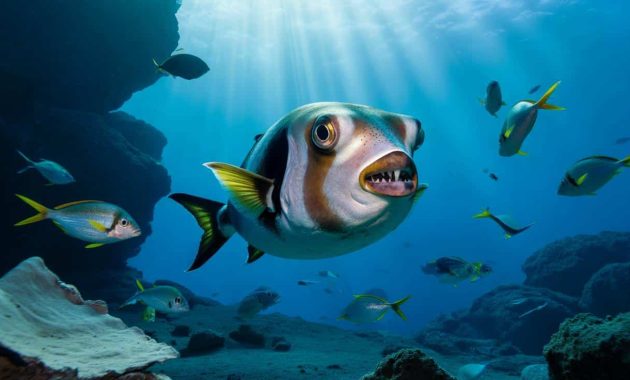
Researchers report that an invasive pufferfish, carrying a potent nerve poison and spreading at speed, is reshaping parts of the Mediterranean Sea and raising new questions about public safety, fishing livelihoods and the resilience of already stressed marine ecosystems.
A toxic intruder turning up on Mediterranean beaches
The species at the centre of growing concern is Lagocephalus sceleratus, often called the silver-cheeked toadfish or pufferfish. Long established in the warm waters of the Indian and Pacific Oceans, it has now entrenched itself across much of the Mediterranean basin.
Croatian scientists from Juraj Dobrila University in Pula and the Institute of Oceanography and Fisheries in Split recently confirmed new sightings along the eastern Adriatic. Similar reports have arrived in recent years from Turkey, Egypt, Tunisia, Greece, Cyprus, Israel and even the French coast near Narbonne.
Once considered a rare curiosity, this pufferfish is now treated by marine experts as a permanent – and dangerous – part of the Mediterranean fauna.
The timing could not be worse. The Mediterranean already faces warming waters, overfishing and the arrival of other so‑called “Leshsepsian migrants” – species that move from the Red Sea into the Mediterranean through the Suez Canal. Lagocephalus sceleratus is among the most worrying of these new arrivals because it can affect people directly.
A fish that can kill without a single bite
The danger of this pufferfish lies less in its teeth and more in what is hidden inside its body. Its flesh and organs contain tetrodotoxin, one of the most powerful natural neurotoxins known.
Tetrodotoxin blocks the sodium channels that nerve cells use to send signals. Once it enters the body, usually through consumption of contaminated fish, the nervous system begins to shut down within minutes to hours.
- Mild exposure: tingling around the mouth, dizziness, nausea.
- Moderate exposure: loss of coordination, slurred speech, muscle weakness.
- Severe exposure: respiratory paralysis, loss of consciousness, potential death.
There is no specific antidote. Treatment focuses on keeping the person breathing and supporting circulation until the toxin is cleared naturally.
Even small amounts of tetrodotoxin can be lethal, and cooking, freezing or drying the fish does not neutralise the poison.
➡️ Iron Water Tank Scaling Up Fast? The Simple Trick That Stops Marks And Breakdowns
On top of that, the pufferfish has a strong beak‑like jaw. Divers and anglers have reported bites capable of taking off chunks of flesh; scientists note that serious finger injuries are entirely possible if the animal is mishandled.
How a tropical species conquered the Mediterranean
Marine biologists trace the arrival of Lagocephalus sceleratus to the Suez Canal, which links the Red Sea to the eastern Mediterranean. The species was first recorded in the region in the early 2000s, and then began to expand rapidly.
Several factors explain its success:
- Few natural predators: Many potential predators are deterred by its toxicity.
- High reproductive rate: The species produces large numbers of eggs, boosting survival odds.
- Warming seas: Rising Mediterranean temperatures suit a fish adapted to tropical waters.
- Human activity: Shipping and coastal development can create new habitats and corridors.
Over just two decades, confirmed sightings have spread from the eastern Mediterranean to the central and western basins, showing how fast an invasive species can establish itself when conditions are favourable.
Ecological and economic shockwaves for coastal communities
The new arrival does not just threaten swimmers or curious tourists. It also interferes with fragile marine food webs and the livelihoods built on them.
| Impact area | Observed or expected effects |
|---|---|
| Marine biodiversity | Predation on native invertebrates and small fish, competition with local species for food and habitat. |
| Fisheries | Damage to nets and lines from powerful teeth, reduced catches of valuable species, discarding of toxic fish. |
| Public health | Risk of poisoning if misidentified and eaten, potential injuries from bites, pressure on emergency services. |
| Tourism | Fear of dangerous wildlife can affect the image of popular beaches and dive sites. |
Experts warn that uncontrolled expansion of the species could further weaken fish stocks that are already under pressure from decades of overfishing.
Some small‑scale fishers in the eastern Mediterranean say they now pull up more pufferfish than saleable catch on certain days, losing time and money cutting the animals out of damaged nets. Because the fish is toxic, there is little market value to offset those losses.
Why Croatian scientists are raising the alarm
The recent Croatian observations matter because they show the pufferfish is pushing into new territory. The Adriatic Sea is bordered by popular tourist hotspots, dense coastal towns and a fishing sector that relies on relatively shallow, coastal waters.
Researchers stress that waiting for problems to escalate would be a mistake. They are calling for coordinated monitoring programmes, shared databases on sightings and common rules on how to handle the species in ports and markets.
Marine teams argue that early action can limit ecological damage, protect fishers and reduce the chances of a serious poisoning case making headlines during peak holiday season.
Authorities in several Mediterranean countries already issue public advisories warning against eating pufferfish sold informally or caught by recreational anglers. Some regions have hotlines where people can report unusual fish so specialists can track the spread in near real time.
What beachgoers, anglers and divers should actually do
For swimmers and snorkellers
Casual swimmers are unlikely to be targeted by the fish, which generally avoids confrontation. Problems tend to arise when people try to touch or catch it. Keeping a respectful distance from unfamiliar marine animals is still the safest rule of thumb.
For recreational fishers
Anglers along Mediterranean coasts are increasingly likely to hook this species by accident. If that happens:
- Do not try to gut, fillet or taste the fish.
- Avoid putting fingers near the mouth; use pliers or a hook‑removal tool.
- Wear gloves when handling, and keep it away from children and pets.
- Follow local guidance on disposal or reporting of invasive species.
Those steps reduce both the risk of serious bites and the chances of the fish ending up in informal food chains.
For coastal residents and tourists
Markets and restaurants in the EU and many Mediterranean states are subject to strict rules that ban the sale of toxic pufferfish species. The higher risk comes from informal sales on docks or from an acquaintance who “knows this fish is safe”. In this case, suspicion can literally save lives: if in doubt, do not eat it.
Why this fish’s toxin fascinates scientists
Oddly, the same toxin that makes Lagocephalus sceleratus so hazardous is also of great interest to medical researchers. Tetrodotoxin has been used for decades in tiny, controlled doses to study how nerves function and to develop pain treatments.
Scientists are investigating whether the toxin, or similar molecules, could form the basis of new anaesthetics or chronic pain therapies that work differently from opioids. That does not make the wild fish any safer, but it shows how a dangerous species can still push research forward in unexpected ways.
Key terms and scenarios people are asking about
Two concepts often appear in discussions of this pufferfish: “invasive species” and “Leshsepsian migration”. An invasive species is a plant or animal introduced, by human activity, outside its natural range, that spreads and causes harm to the environment, economy or human health. Leshsepsian migration refers specifically to movements of marine species through the Suez Canal, named after the canal’s 19th‑century engineer Ferdinand de Lesseps.
Scientists run computer simulations to estimate what might happen if this pufferfish continues to expand unchecked. In one scenario, its population stabilises at moderate levels, adding pressure but not collapsing local ecosystems. In a harsher scenario, continued warming and lack of management allow numbers to spike, crowding out native species, cutting into fishers’ earnings and leading to more frequent poisoning incidents. Real‑world outcomes will depend on how quickly coastal states coordinate and how seriously the public takes warnings.
For now, the message from experts is straightforward: the Mediterranean is changing, and the silver‑cheeked pufferfish is a visible sign of that shift. Staying informed about what lives beneath the surface – and what risks come with it – has become part of living, working or holidaying along one of the world’s most visited seas.