Others outlive empires. A single dessert has forced archaeologists to rethink how long flavor can last.
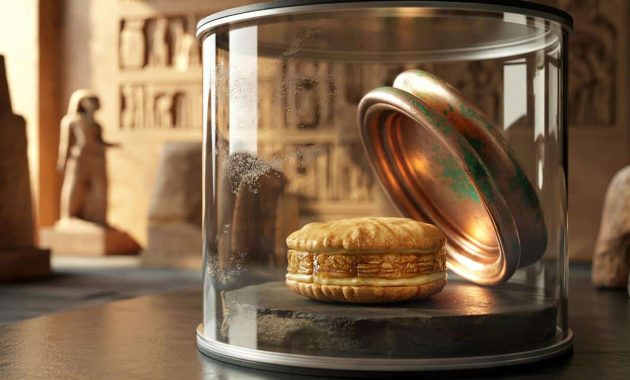
Inside a Swiss food museum, a compact pastry from ancient Egypt sits under glass, intact and oddly inviting. Its survival across four millennia challenges modern ideas about freshness, storage, and just how clever ancient cooks could be.
A record that defies belief
Guinness World Records lists the display as the oldest known cake. It was recovered from the necropolis of Meir, a burial ground on the Nile’s western bank. The piece comes from the tomb of Pepyankh the Middle, a high-ranking vizier who served under the long-reigning pharaoh Pepi II.
The cake is modest in size but complex in design. Two wheat discs, each about 10 centimetres across, sandwich a filling based on milk, honey, and sesame. The form looks closer to a pastry than simple bread. Its profile and edges remain crisp, a detail that still puzzles visitors and excites conservators.
Oldest known cake, intact shape and structure, linked to Pepi II’s court, now conserved in Vevey, Switzerland.
Its ingredients were not simply culinary choices. Honey brings low water activity and natural acidity. Sesame contributes antioxidant compounds and protective oils. Milk adds richness but typically spoils fast, which makes the success of the overall method even more striking.
The technique that kept it fresh
The real trick appears to lie in the hardware. Ancient bakers used interlocking copper molds engineered to fit together snugly. The molds were preheated and then clamped around the wet dough and its filling. Heat met moisture. Air expanded and formed bubbles. As the molds cooled, the air contracted and seeped out through microscopic gaps, creating a mild vacuum inside.
That vacuum effect lowered oxygen exposure during and after baking. The cake pressed tightly against the mold walls, leaving few pockets where moisture could pool or microbes could flourish. Copper’s excellent heat conduction produced a quick, even bake, drying the outer layers and helping the internal filling set firmly.
A primitive vacuum seal, achieved with hot copper molds and cooling air, likely shielded the pastry from oxygen and humidity.
Why honey and sesame matter
Honey is naturally hygroscopic and acidic, a combination that hampers bacterial growth. Its enzymes generate small amounts of hydrogen peroxide, which further slows microbes. Sesame seeds and oil supply sesamin and sesamol, antioxidants that resist rancidity. Together, the pair stabilised the filling while the shell stayed dry and dense.
➡️ HVAC pros explain why closing vents in unused rooms actually increases heating bills
➡️ I tried this skillet apple crumble and now I make it year-round
➡️ The grossest part of your home you never clean: a cleaning expert’s trick
➡️ The French regions where grocery shopping is cheapest
➡️ The reason raised beds dry out faster and how to fix it long-term
➡️ How to recognize when your body is telling you to slow down before you burn out
- Honey’s water activity sits too low for most bacteria and molds to thrive.
- Sesame’s antioxidants delay oxidation of fats, limiting off-flavours.
- A tight, oxygen-poor cavity reduces the pace of spoilage reactions.
- Copper molds spread heat quickly, driving off excess moisture at the surface.
| Component | Role in preservation |
|---|---|
| Honey | Lowers water activity; acidic pH; mild antimicrobial action |
| Sesame | Provides stable oils and antioxidants; slows rancidity |
| Copper molds | Even heat; partial vacuum on cooling; reduced oxygen exposure |
Made for a journey beyond
This cake was not a snack for the living. It was a supply for the dead. Egyptian belief placed the tomb as a launch point toward the Field of Reeds, a perfected mirror of earthly life. Funerary provisions aimed to nourish the traveler through rituals and trials.
The quality of the offering mattered. Priests curated menus that could endure. A spoiled item risked denying the deceased sustenance in the next stage. A cake that stayed whole sent a message of care, status, and order within the tomb’s microcosm.
An immortal-looking cake signalled wealth on earth and readiness for eternity in Egyptian funerary thinking.
From tomb to museum
The pastry now sits at the Alimentarium, the food museum in Vevey, Switzerland. Curators stabilised the artifact using low light, controlled humidity, and inert supports. They avoid chemical treatments that might alter residues relevant for analysis.
Context and inscriptions in the tomb link the find to Pepi II’s period, dated roughly 2251–2157 BCE. Researchers rely on the burial layout, nearby objects, and stylistic markers to place it in time. Any sampling for dating must balance science with strict conservation ethics.
Guinness certification reflects a bundle of checks. The registry looks for peer-reviewed evidence, clear provenance, and institutional stewardship. The museum’s records, excavation notes, and independent expert opinions support the claim.
What a modern cook can take from it
Food scientists would point to water activity first. Most microbes cannot grow below an aw of about 0.6. Pure honey often falls under that threshold. Mixing honey with milk raises the aw, but drying the sandwich quickly and enclosing it in a low-oxygen space pulls the risk back down.
Home bakers can borrow ideas without copying the tomb method. A firm outer shell, a low-moisture sweetener, and efficient heat all improve shelf life for pastries. Modern equivalents include vacuum bags, oxygen absorbers, and low-aw fillings like nut pastes bound with honey.
Do not use makeshift vacuum setups for fresh dairy fillings at home. Clostridium botulinum thrives in low-oxygen environments if moisture and warmth persist. Safe canning and dehydrating procedures, tested by food safety bodies, remain the standard for long storage.
Related finds and broader context
The Meir cake joins a small club of ancient foods preserved by chance and craft. Archaeologists have documented carbonised loaves at Pompeii, jars of “bog butter” from Ireland, and beer residues from Egyptian breweries. Each item reveals techniques tuned to climate, materials, and belief.
Egyptian bakers worked with emmer and barley, but wheat-based ceremonial items show up in elite contexts. Copper tools were valued for their heat performance and antimicrobial properties, qualities that also feature in modern kitchens. The Meir example suggests workshops capable of repeatable results and precise thermal control.
The find also spotlights a ruler’s exceptionally long reign. Pepi II may have governed for decades, creating stable conditions for artistic and ritual standardization. That stability could explain the skilled workflows seen in the molds and the pastry’s uniform geometry.
Practical takeaways for today
Travel foods still rely on the same principles. Dry more, seal tighter, and keep air away from fats. Backpackers use honey, nut butters, and dense breads for exactly these reasons. Artisan bakers adapt similar logic for filled cookies and holiday cakes meant to age gracefully.
Museums handling edible artifacts face unique risks. Organic items invite pests and decay if conditions slip. Best practice includes sealed vitrines, constant temperature, and periodic checks for micro-cracking. Conservators document any change in shape to assess stress on the item.
Curious minds can test the science safely with a simple kitchen simulation. Make two small wheat crackers. Spread a thin layer of honey-sesame paste between them. Weigh the sandwich before and after a low, slow bake. Track weight loss to estimate moisture reduction. Store half in a sealed jar with an oxygen absorber and half loosely wrapped, then monitor texture and aroma over two weeks. The sealed sample should hold its snap longer, illustrating the core principle behind the ancient technique.
The Meir cake speaks to a blend of chemistry, skill, and ritual. It hints at workshops where artisans understood heat, moisture, and time not as abstractions but as daily tools. It also shows how a humble pastry can carry theology, status, and technical flair into the present day, one preserved crumb at a time.