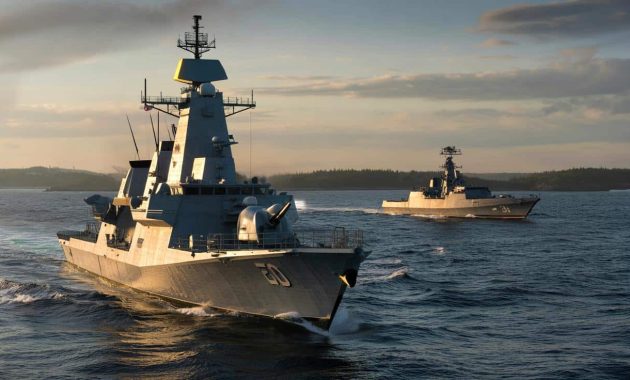
The Nordic country is about to pick a new generation of warships, and the shortlist looks very familiar: France on one side, the UK on the other. Behind the polite diplomatic smiles, a fierce industrial contest is underway – and Paris believes it holds a very simple, very concrete edge.
Sweden’s ‘Luleå’ program: four ships, decades of consequences
Stockholm’s “Luleå” program aims to replace its Visby-class corvettes with four fully fledged frigates between 2030 and 2035. These new ships are expected to be larger, better armed and tightly meshed with NATO systems, reflecting Sweden’s recent alliance membership and a more dangerous Baltic Sea.
Current estimates from defence analysts suggest a unit price somewhere between €700 million and €900 million per frigate, depending on weapons fit, local industrial workshare and onboard systems.
The full contract could push beyond €3 billion, making it one of Europe’s defining naval deals of the decade.
For Sweden, this is not just about buying hulls. It is a long-term bet on how the country will defend its coasts, support allies in the Baltic and keep its shipyards and high-tech firms busy until at least the 2050s.
Paris vs London: old rivalry, new battleground
The competition has boiled down to two European offers:
- France’s Frégate de Défense et d’Intervention (FDI), already ordered by the French and Greek navies.
- The British Arrowhead-140, the export version of the Royal Navy’s new Type 31 frigate.
Both pitches come wrapped in promises of industrial cooperation and NATO interoperability. Yet the political backdrop is very different.
France and Sweden already share defence projects. They work together on anti-tank weapons, long-range strike initiatives and coastal warfare. Sweden has even lent CB90 fast boats to the French Navy, an unusual gesture of trust between European partners.
Paris has worked hard to deepen that bond. The first French FDI, the frigate Amiral Ronarc’h, is due to visit Gothenburg in early 2026, almost like a floating showroom directed at Swedish admirals. France has also publicly stated its plan to buy Saab’s GlobalEye surveillance aircraft, tying Swedish industry into French defence plans far beyond the naval sphere.
➡️ Day will turn to night: the longest total solar eclipse of the century now has an official date
➡️ A sunny corner, five well‑chosen plants and the butterflies move in for the season
➡️ How bananas can stay fresh and yellow for up to two weeks when stored with one simple household item
➡️ The airport worker trick that makes your suitcase come off the belt first
France is selling more than a ship to Sweden; it is selling the idea of a balanced, long-haul defence partnership.
The French trump card: time to delivery
For Stockholm, deadlines are not a mere contractual detail. Swedish officials want two frigates operational by around 2030, in sync with their plan to contribute fully to NATO’s air and missile defence shield over northern Europe.
Here lies France’s main argument: FDI frigates are already in production. The lead ship for the French Navy is delivered, and the first Greek unit is being fitted out. The production line exists, the design is mature, and the supply chain is running.
French defence minister Catherine Vautrin has said Paris could hand over a fully equipped frigate to Sweden by 2030. That includes radar, missiles, electronic warfare systems and embarked helicopter – not a bare hull awaiting tools and weapons.
The British side cannot yet claim the same. The Type 31 program is facing delays, with the first UK ship, HMS Venturer, not expected to become operational before the late 2020s. The Arrowhead-140 is based on a proven Danish design, but in its British form it is still moving from paper to reality.
In naval procurement, a working production line often weighs more than glossy brochures or beautiful artist’s impressions.
What France is actually putting on the table
A modular, all-European combat package
Naval Group, the French prime contractor, is framing the FDI as a ready-made but flexible toolkit. The proposed Swedish version would integrate a set of European systems already known to NATO navies, including:
- Sea Fire radar: an active electronically scanned array, designed to track high-speed missiles, aircraft and drones.
- KingKlip Mk2 hull sonar and CAPTAS-4 towed sonar: for submarine hunting in both shallow Baltic waters and deeper seas.
- SENTINEL electronic warfare suite: for detecting, jamming and deceiving enemy sensors.
- Aquilon communications: natively compatible with NATO standards and secure data links.
- Weapons package: Aster 15/30 surface-to-air missiles, Exocet anti-ship missiles, MU90 torpedoes, a 76 mm main gun, remote 20 mm cannons and space for drones.
Each of these blocks can be tailored to Swedish preferences. Stockholm could, for instance, push for greater integration of Saab combat systems, local communications gear or Swedish-developed missiles in the longer term.
Naval Group is also stressing local involvement. The proposal includes coproduction, subcontracting and integration work with Saab and other national players. That means jobs and technology transfer for Sweden rather than a pure “off-the-shelf” import.
The British and Danish angle: geography vs guarantees
Arrowhead-140 and the Nordic card
The UK is not arriving alone. Babcock, the British shipbuilder behind Arrowhead-140, has teamed up with Saab Kockums, a familiar name in Swedish shipbuilding.
The Arrowhead design itself traces back to Denmark’s Iver Huitfeldt-class frigates, which already operate in northern waters. That gives London a convincing narrative: a ship based on a Scandinavian-friendly hull, supported by British experience and Swedish industrial know-how.
Arrowhead-140 is promoted as a flexible and cost-conscious frigate, more of a generalist workhorse than a specialised air-defence ship. For Sweden, that raises a real question: does it want a multi-mission platform with strong affordability, or a vessel optimised for high-end air and missile defence at sea?
Another unknown is political alignment in the region. If Denmark were to select the same design for its own future upgrades, a shared Arrowhead family across Nordic fleets could make logistics, training and exercises easier.
Regional standardisation is tempting, but it does not erase the risks tied to a program still maturing and running late.
Head-to-head: FDI vs Arrowhead-140 in key figures
Some of the main features compared:
| Criterion | FDI (France) | Arrowhead-140 (UK) |
|---|---|---|
| Length | Approx. 122 m | Approx. 139 m |
| Displacement | About 4,500 tonnes | About 5,700 tonnes |
| Main radar | Sea Fire AESA | Typically NS100 or similar, depending on customer choice |
| Air-defence missiles | 16–32 Aster 15/30 | Up to 32 Sea Ceptor (CAMM) |
| Towed sonar | Included (CAPTAS-4) | Optional, depending on configuration |
| Earliest realistic delivery to Sweden | Operational frigate by 2030 | From roughly 2031–2032 |
| Industrial partnership | Proposed with Saab and local yards | Planned via Saab Kockums |
| Program maturity | Ships already delivered and in series | First units still in construction |
What this means for NATO and Baltic security
The choice Sweden makes will shape NATO’s posture in the Baltic Sea. A high-end air-defence frigate fitted with a powerful radar like Sea Fire could act as a floating sensor node and missile shield for allied forces in the region.
In a crisis, such ships would help protect convoys moving reinforcements to the Baltic states, and monitor Russian air and naval activity from the Gulf of Finland down to the Danish straits. For NATO planners, every extra modern frigate in this area is a serious asset.
Sweden’s decision also carries an industrial signal. Siding with Paris would reinforce a growing French-Swedish axis in advanced defence technologies. Picking the British offer would reinforce ties to London and to a broader Nordic-British cluster built around Danish designs.
Key terms and what they really mean for Sweden
Air-defence frigate vs “general purpose” ship
An air-defence frigate focuses on tracking and intercepting aircraft and missiles at long range. It carries powerful radar, advanced combat systems and vertical launch cells packed with surface-to-air missiles.
A general-purpose frigate balances tasks: anti-submarine warfare, surface combat, patrol, escort duties. It can still carry air-defence missiles, but the radar and missile load may be less ambitious. Sweden must decide where its priorities lie in the Baltic: constant high-end air cover, or a jack-of-all-trades fleet.
Industrial offsets and political risk
Defence tenders of this size rarely turn on technical performance alone. Offset agreements – local assembly, research projects, maintenance contracts – can be as valuable to governments as the hardware itself.
France and the UK are both promising Swedish industry a serious role. The risk for Stockholm is locking itself into a partner that later cuts defence spending, shifts strategy or faces program overruns. That is why program maturity, existing export customers and a track record of deliveries are watched closely by Swedish officials.
Another angle is resilience. By mixing Swedish systems with either French or British platforms, Stockholm can avoid overdependence on a single supplier. That could soften future political shocks, trade disputes or export restrictions inside Europe.
Sweden is not just buying four warships; it is choosing which supply chains, alliances and technologies will anchor its navy for the next thirty years.