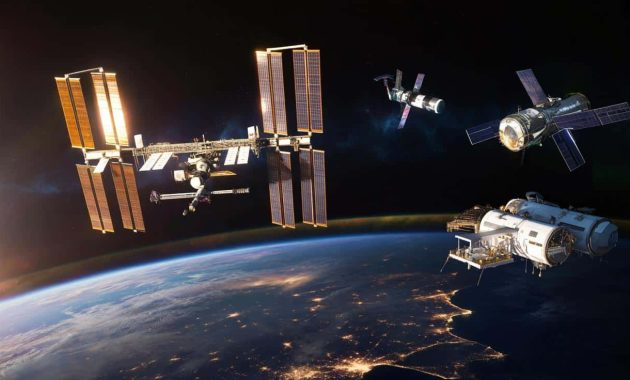
On a quiet night, you can still see it sliding across the sky like a slow, steady star.
Somewhere above the dark curve of Earth, the International Space Station creaks softly, its solar arrays flexing, laptops humming, crew members drifting between experiments and the window.
Floating there, they already know: this home between worlds has an expiry date.
NASA has circled a year on the calendar — 2030 — not as a random number in a speech, but as the beginning of a real goodbye.
After more than two decades of life in orbit, the ISS will pass the torch to something new, something less “government lab” and more “commercial hub”.
The question isn’t only what comes next in space.
It’s who gets to be up there.
The slow farewell to a metal giant in the sky
If you grew up with space posters on your wall, the ISS probably felt eternal, like the Moon or the word “NASA” stitched on a blue flight suit.
Yet inside the agency’s Houston offices, planners talk about the station using phrases like “end-of-life” and “deorbit strategy”.
The timeline is surprisingly clear.
NASA wants to keep the ISS safely running through 2030, then send it on a controlled descent into the remote waters of the South Pacific.
No dramatic movie-style breakup raining metal over cities.
Just a slow, carefully planned retirement of the most expensive human-made object in orbit.
There’s something strangely tender in that idea.
On the screens at Mission Control, the station is a set of numbers: pressures, voltages, orbit tracks.
But the hardware is aging, piece by piece.
➡️ Washing your hair with white vinegar: why it’s recommended and what it really changes
➡️ Neither baking soda nor lemon: the magic trick to clean toilet urine and erase the smell
➡️ This plant naturally perfumes the home and repels mosquitoes, here’s why everyone wants it in spring
➡️ The overlooked reason sticky notes stop working after a few weeks
➡️ Goodbye balayage : “melting,” the technique that makes gray hair forgettable
Some modules are more than 20 years old.
Small air leaks have appeared over the years, valves have been swapped, computers upgraded, toilets repaired, cables rerouted like a never-ending renovation of a very cramped, very fragile house.
In 2022, NASA’s Office of Inspector General bluntly warned that maintaining the ISS beyond 2030 could become risky and extremely expensive.
The cost already hovers around $3–4 billion a year for NASA’s share alone.
That’s more than some entire national space budgets.
You don’t need to be an accountant to hear the subtext: this model has reached its limit.
The logic behind the goodbye is cold and clear.
The ISS is a marvel, but it’s also a monopoly: one giant lab owned by governments, with limited spots and enormous fixed costs.
NASA wants to redirect that money into Artemis lunar missions, Mars prep, advanced spacecraft, deep space science.
To do that, it needs to stop paying rent on a single, aging orbital megaproject.
*Enter the next chapter: not one big space station, but several smaller, privately run platforms.*
The ambition is bold.
Let companies build, own, and operate stations, while NASA becomes a customer among others — still powerful, still a driver, but no longer the landlord of low Earth orbit.
From government lab to orbital business park
NASA’s plan has a simple backbone: hand low Earth orbit over to the market.
Not in a “space casino” way, but as a structured ecosystem where research, tourism, industry, and national agencies buy time and room in orbit.
To make that real, NASA has already funded a first wave of commercial station projects.
Think of them as prototypes for the post-ISS era.
There’s **Orbital Reef**, led by Blue Origin and Sierra Space, marketed as a “mixed-use business park” in space.
Starlab, from Voyager Space and Airbus, aims to be a compact, continuously crewed lab.
And Axiom Space is already attaching new commercial modules to the ISS, planning to detach them later as a free-flying station.
Like a tenant slowly building their own house from an attached extension.
Axiom might be the clearest preview of the near future.
Its first module is expected to reach the ISS later this decade, bringing new lab space, private astronaut quarters, maybe even better windows than the famous Cupola.
The idea is simple: grow commercial infrastructure while the ISS is still alive.
Learn the rhythms of tourism missions, pharma experiments, materials testing, media projects — all the things that could pay the bills once NASA subsidies shrink.
Then, sometime after 2030, Axiom’s modules detach.
They become an independent station, no longer needing the old backbone.
Starlab and Orbital Reef are racing toward similar milestones, each with its own design quirks and business promises.
For NASA, the hope is that at least one — preferably several — of these stations will be fully operational before the ISS takes its final plunge.
Behind the glossy renderings and dramatic videos, there’s a hard-edged calculation.
NASA calculates it can cut its annual low-Earth-orbit costs dramatically by renting space and services, instead of owning and running everything.
If multiple stations exist, universities, startups, foreign agencies, and even media companies could negotiate their own deals.
Competition breeds innovation, lower prices, and new services — at least, that’s the classic capitalist script being played in orbit.
Let’s be honest: nobody really does this every single day, but space people are already rehearsing how to sell “microgravity time” the way we book cloud computing or airline seats.
At the same time, this shift changes who gets power in space.
Government agencies step back from running the hotel, and private actors decide who gets the best rooms, the most bandwidth, the prime Earth-viewing windows.
We’ve all been there, that moment when something public slowly turns into a private service — and access starts to look a little different.
How this new space economy might actually work for humans on Earth
If you strip away the acronyms and headlines, the new model rests on one core idea: low Earth orbit becomes a service.
Need to test a drug in microgravity? You buy experiment time.
Want to film a reality show or a movie? You purchase a mission with trained private astronauts and a chunk of station real estate.
NASA, ESA, JAXA and others do the same for their science.
They no longer carry the weight of maintaining the entire platform; they pay for specific outcomes: data, crew time, completed experiments.
For companies on the ground, this is more familiar territory.
Contracts, service-level agreements, pricing tables, optional extras.
It sounds technical, but it’s how you make space feel less like a moonshot and more like a serious, if exotic, line in a corporate budget.
There’s a catch many people feel instinctively: what if this all ends up being “space for the rich”?
It’s a fair worry when you see tickets for short tourist flights costing tens of millions of dollars.
NASA is very aware of that image.
Part of its strategy is to anchor these stations with public research: medical studies, Earth observation, climate monitoring, fluid physics, fundamental biology.
Those experiments directly feed into things like cleaner manufacturing, better vaccines, new materials, improved remote sensing of forests and oceans.
If the cost of doing research in orbit goes down because stations are cheaper to run, the number of experiments — and the chances of useful discoveries — can rise.
Empathetically, it’s easy to feel a bit torn here.
The same infrastructure that hosts a billionaire’s selfie at the window might also host a trial that leads to a life-saving therapy back home.
NASA’s leadership likes to repeat a simple phrase: “We want to be one customer of many in low Earth orbit.”
Behind that sentence lies a quiet revolution in how space is funded, governed, and imagined.
-
Democratized access (relatively speaking)
As multiple stations compete, there’s at least a chance prices fall over time.
That could open doors for smaller nations, universities, and startups that never had a shot at a dedicated ISS slot. -
Orbital specialization
One station could lean into high-end tourism, another into biotech, another into manufacturing or robotics.
This kind of “zoning” in microgravity might accelerate specific sectors instead of cramming everything into a single lab. -
Risk and resilience
A single ISS is a single point of failure.
Several smaller stations spread the risk — a technical issue on one doesn’t shut down humanity’s entire presence in low Earth orbit.
After 2030: a quieter sky, a busier orbit
If you fast-forward in your mind to the early 2030s, the sky doesn’t really look different to the naked eye.
The ISS vanishes from satellite trackers, a new cluster of names appears: Axiom Station, Starlab, Orbital Reef or whatever survives the harsh economics of space.
On the surface of Earth, though, the change is deeper.
Space becomes less of a distant, symbolic frontier and more like a messy, bustling harbor full of private docks and government ships pulling in for scheduled work.
Some people will feel nostalgia when that long, bright line in the sky disappears.
The ISS was a rare symbol of cooperation in a divided world, a place where Russian and American astronauts floated side by side while politics on the ground froze.
What replaces it may feel more fragmented, branded, transactional.
Yet it might also be more open to new players, surprising uses, unexpected stories.
| Key point | Detail | Value for the reader |
|---|---|---|
| ISS retirement in 2030 | NASA plans a controlled deorbit of the station into the South Pacific after extending operations to 2030. | Helps you grasp why this “end of an era” matters and when it will actually happen. |
| Rise of commercial stations | Projects like Axiom Station, Starlab, and Orbital Reef aim to host research, tourism, and industry in orbit. | Shows how space access is shifting from government-only to a mixed public–private model. |
| New space economy logic | NASA transitions from owning infrastructure to buying services as “one customer of many”. | Gives you a clear lens to read future space news and spot real opportunities from hype. |
FAQ:
- Question 1Why is NASA retiring the International Space Station in 2030?
- Answer 1The hardware is aging, maintenance costs are huge, and risks grow with time. NASA also wants to free up billions of dollars a year to fund Artemis lunar missions, Mars preparation, and new tech, rather than indefinitely supporting one old station.
- Question 2Will the ISS just fall out of the sky uncontrolled?
- Answer 2No. The plan is a controlled deorbit, using propulsion to guide the station into a remote region of the South Pacific known as the “spacecraft cemetery”, minimizing risk to people and infrastructure on Earth.
- Question 3What exactly are commercial space stations?
- Answer 3They’re privately owned and operated platforms in low Earth orbit. Companies build and manage them, while customers — including NASA, other agencies, universities and businesses — pay for research time, cargo, crewed missions, or even tourism.
- Question 4Will ordinary people ever visit these stations?
- Answer 4“Ordinary” is relative. For now, seats are astronomically expensive, aimed at ultra-wealthy tourists and trained private astronauts. Over time, if competition grows and tech improves, prices could drop, opening the door to more diverse visitors.
- Question 5Does this shift mean governments are abandoning space?
- Answer 5Not at all. Agencies like NASA are focusing their direct spending on deep space, Moon and Mars missions, and high-end science. They still shape the rules, fund research, and anchor demand — they just don’t want to run every “space hotel” themselves anymore.